
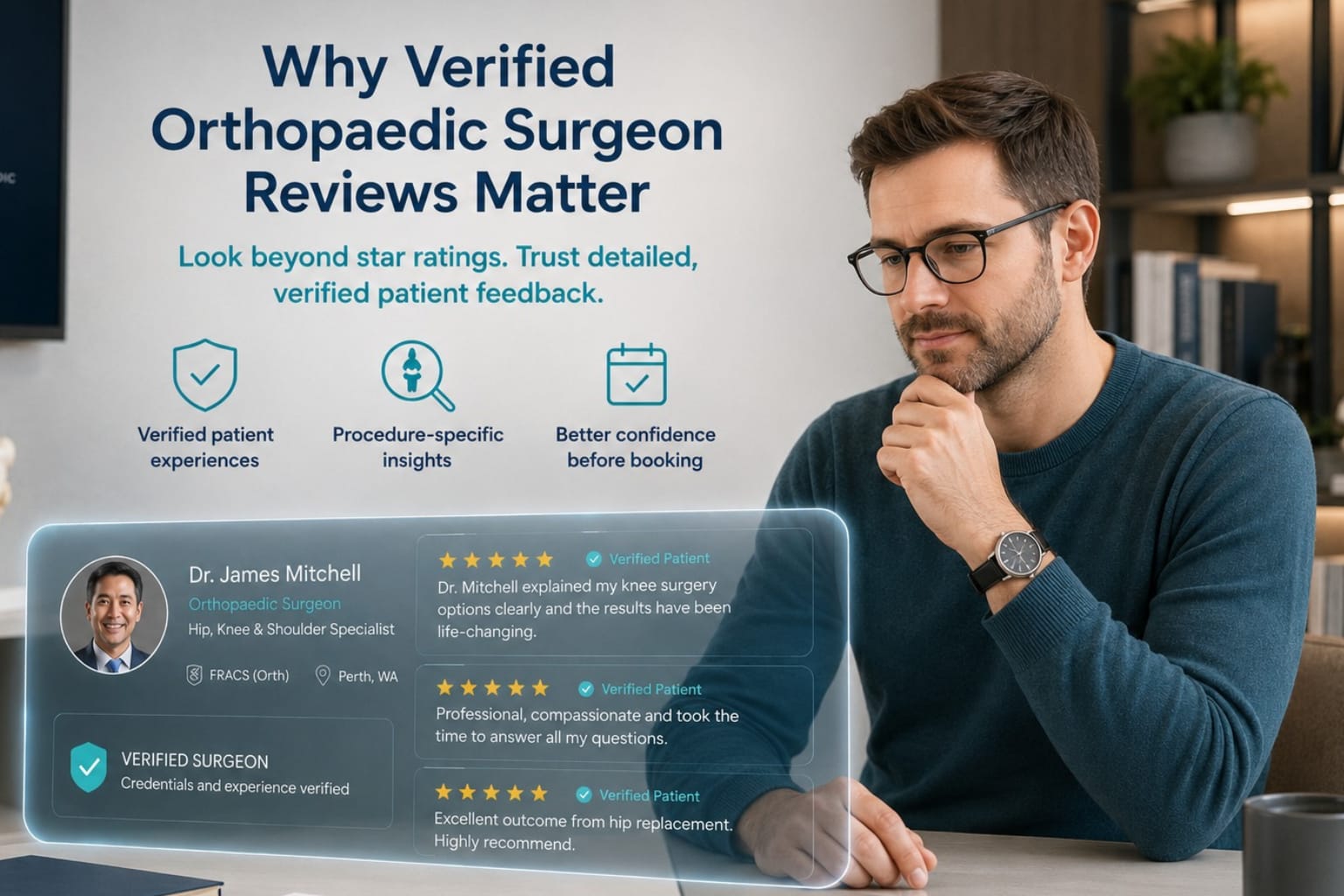

Why Verified Orthopaedic Surgeon Reviews Matter for Your Decision
Orthopaedic surgeon reviews vary widely in usefulness. Knowing how to read them can make the difference between a confident decision and an expensive guess.
Picture this: you need a knee specialist in Perth. You search online, find thirty surgeons, scan a wall of star ratings, and have absolutely no idea what any of it tells you about surgical skill. A rating of 4.9 stars sounds reassuring. But if those stars came from anonymous accounts, unconfirmed patients, or reviews that only mention how friendly the front desk was, they tell you nothing meaningful about the person who may be operating on your joint.
This is the problem with how many people use surgeon ratings. They read the number rather than the story behind it. For a decision as significant as orthopaedic surgery, that shortcut carries real risk.
A surgeon with 4.7 stars and forty detailed, procedure-specific reviews from confirmed patients gives you much stronger grounds for confidence than one with 5.0 stars and eight vague comments posted over a single weekend.
By the end of this article, you'll understand what to trust, what to question, and how to use patient feedback to build a confident shortlist. Best Orthopaedic Surgeons (BOS) has built its platform around transparent, verified feedback for patients searching for orthopaedic specialists across Perth and regional Western Australia.
What Makes Orthopaedic Surgeon Reviews Worth Reading?
A useful review tells a specific clinical story. It does not simply say, "Great surgeon."
It tells you what procedure the patient had, how their pain changed afterwards, whether the surgeon explained the recovery timeline clearly, and how any complications or concerns were handled.
The real value of a review lies in its clinical and experiential detail, not its star count. Strip away the stars, and what remains either provides useful information or it does not.
Genuine patient reviews for orthopaedic procedures often follow a recognisable pattern. They may mention:
- The initial consultation
- What the surgeon explained before treatment
- The procedure performed
- What recovery was actually like
- How accessible the surgeon or clinical team was afterwards
- Whether the outcome matched the patient's expectations
Detailed accounts of ACL reconstruction, hip replacement, rotator cuff repair, knee surgery, or another specific procedure are more likely to reflect genuine clinical experience than short, generic praise.
Procedure-specific reviews are also more difficult to fabricate convincingly because they include details that usually come from someone who has actually experienced the treatment and recovery process.
The Patient Experience Factors That Carry Real Weight
Patients reporting the most positive outcomes frequently focus on three factors:
- Pain relief
- Functional improvement
- Whether the result matched the expectations set before surgery
These factors generally carry more weight than waiting-room appearance, parking convenience, or general staff friendliness.
A review that explains whether a patient can now walk without pain, return to sport, sleep comfortably, work again, or manage daily activities provides genuinely useful information.
Communication and bedside manner also matter. Patients who felt informed about their recovery, had their questions answered clearly, and trusted the surgical team commonly report higher satisfaction.
When reviews specifically praise a surgeon for setting realistic expectations, explaining risks clearly, or being available during recovery, that can reflect the quality of clinical care rather than personality alone.
Why Star Ratings Alone Tell You Almost Nothing
A five-star average can hide important information:
- How many reviews sit behind the score
- Whether the reviewers were verified patients
- Whether the feedback relates to surgery or administrative service
- Which procedures the reviews refer to
- Whether the reviews were collected naturally over time
Two surgeons can have the same overall score while differing significantly in subspecialty expertise, communication quality, procedure experience, and how patients describe their recovery.
The overall number does not show those differences. The content of the orthopaedic surgeon reviews does.
Review volume, specificity, procedural relevance, and verification are the strongest signals. A large collection of detailed, confirmed accounts of knee and hip outcomes tells a much stronger story than a small collection of vague five-star posts.
Verified vs Unverified Reviews: The Gap You Cannot Ignore
Before reading a review about any surgeon, you need to understand one foundational distinction.
A verified review means the platform has taken steps to confirm that the reviewer was an actual patient of that surgeon or practice.
An unverified review may come from anyone with an internet connection, including someone who never attended an appointment.
This distinction is not merely technical. It changes how much weight the review deserves.
How Appointment-Confirmed Review Systems Work
Healthcare-specific platforms may verify feedback through appointment records, booking confirmations, anti-fraud software, human moderation, or clinical governance processes.
An important feature of a credible review system is independence. Healthcare providers should not be able to change their ratings, remove criticism simply because it is inconvenient, or inflate their score using feedback from people who were not patients.
Some healthcare platforms connect reviews directly to booked and attended appointments. This creates a clearer link between the person leaving the review and the clinical experience being described.
Appointment-confirmed reviews provide stronger evidence than comments posted on platforms that do not verify whether the reviewer ever attended the clinic.
Where BOS Fits for Western Australian Patients
For people searching for an orthopaedic specialist in Western Australia, the geographic relevance of a review platform also matters.
A national directory may show a Perth surgeon's profile, but the surrounding information may not reflect the referral pathways, health-fund arrangements, hospital systems, or regional access challenges experienced by WA patients.
BOS focuses specifically on orthopaedic specialists across Western Australia, with surgeon profiles, subspecialty filtering, and patient feedback designed around the local healthcare environment.
For patients in Perth, Fremantle, Bunbury, Geraldton, and other parts of WA, locally relevant feedback can be more useful than ratings drawn from a broad national pool.
Red Flags That Suggest a Review Profile May Not Be Genuine
Even when a platform moderates reviews, certain patterns may suggest manipulated, biased, or unreliable feedback.
The goal is not to distrust every review. It is to read reviews actively rather than passively.
Looking only at the average rating is not the same as evaluating the review profile.
Warning Signs in the Review Text
One of the clearest warning signs is a review with no procedure-specific detail.
Genuine orthopaedic patients often mention something clinical, such as:
- The procedure they underwent
- How the consultation was handled
- What recovery involved
- Whether physiotherapy was required
- How a complication or concern was addressed
A review consisting entirely of phrases such as "absolutely amazing surgeon" or "highly recommend" may still be genuine, but it provides very little useful evidence.
Reviews that read like polished marketing copy are another warning sign. Authentic patient feedback often contains rough edges, personal details, and balanced observations.
Real patients may mention the difficult parts of recovery, delays, physiotherapy challenges, pain levels, or the point at which improvement became noticeable. Scripted reviews usually avoid that nuance.
Suspicious Patterns Across a Review Profile
Look for patterns such as:
- A sudden cluster of five-star reviews posted within a short period
- Nearly identical language across multiple reviews
- A complete absence of moderate or mixed feedback
- Reviews that discuss no specific procedure or clinical experience
- Multiple reviews from accounts with no other activity
No high-volume surgical practice produces an identical experience for every patient. A profile containing nothing but perfect, highly polished praise deserves closer examination.
The opposite pattern can also be misleading. A sudden cluster of harsh, one-line reviews from new accounts may suggest coordinated negative activity rather than genuine patient dissatisfaction.
Credible negative reviews usually include details about what happened, when it occurred, and how the clinic or surgeon responded.
A trustworthy review profile often contains a range of experiences, consistent clinical detail, and professional responses from the practice.
Which Platforms Show Reliable Orthopaedic Surgeon Ratings?
Not all review platforms treat medical feedback in the same way. That difference matters when choosing a surgeon rather than a restaurant or hotel.
General Platforms: Useful Reach, Weaker Verification
General review platforms have enormous reach, but they typically do not confirm that a person attended a medical appointment.
They may still be useful for assessing practical aspects of a clinic, such as:
- Ease of finding the practice
- Reception and scheduling processes
- Parking or accessibility
- Repeated administrative complaints
- General communication from clinic staff
However, general platforms are less reliable for assessing surgical skill, complication management, clinical decision-making, or subspecialty outcomes.
Specialty and Appointment-Verified Platforms
Healthcare-specific platforms may use structured scoring, human moderation, appointment confirmation, and clinical governance systems.
These processes can make their reviews more useful for understanding confirmed patient experiences with medical specialists.
For patients specifically searching for orthopaedic specialists in Western Australia, BOS provides a platform focused entirely on this specialty and region.
BOS surgeon profiles can be explored by:
- Knee surgery
- Hip surgery
- Shoulder surgery
- Spine surgery
- Sports injuries
- Foot and ankle surgery
- Paediatric orthopaedics
- Location
- Condition treated
That level of subspecialty detail helps patients focus on reviews from people who underwent similar procedures rather than relying on a generic collection of medical feedback.
How to Build a Shortlist Using Orthopaedic Surgeon Reviews
Reading reviews should not be the final step in choosing a surgeon. It should form the foundation of a shortlist.
Moving from "I need an orthopaedic specialist" to "I have booked the right surgeon" requires several deliberate checks.
Cross-Reference Reviews Across Multiple Sources
Review at least two sources before selecting a candidate.
A surgeon with strong verified feedback on a specialist healthcare platform and a consistent pattern of credible reviews on a general platform provides a stronger signal than either source alone.
Consistency across platforms is generally more difficult to manipulate than a single strong profile.
Match Reviews to Your Specific Condition
Filter reviews by relevance rather than rating alone.
A surgeon may have excellent feedback for total hip replacement but limited experience or feedback relating to sports injuries, paediatric care, shoulder surgery, or spinal conditions.
A general five-star average may show that the surgeon is broadly well regarded. Reviews relating to your specific operation provide much more useful information about what you may experience.
Verify Qualifications Before Booking
Orthopaedic surgeon reviews are a starting point, not the final verification step.
Once a surgeon reaches your shortlist, confirm their registration through the AHPRA Practitioner Register.
Search by name, confirm that the surgeon holds current specialist medical registration, and review whether any conditions or restrictions appear on the public profile.
Fellowship training and subspecialty background may also be checked through professional associations, surgeon profiles, hospital appointments, and recognised training institutions.
Once these checks are complete, use a specialist platform such as BOS to explore the surgeon's profile and contact the practice.
In Australia, a GP referral is generally required to access Medicare rebates for specialist consultations. If you have not yet visited your GP about the condition, that is usually the appropriate first step.
Make Your Surgeon Search Work Harder for You
Many people spend more time researching household purchases than they spend evaluating the surgeon who may operate on them. That is worth changing.
Knowing how to evaluate orthopaedic surgeon reviews gives you greater control over your healthcare journey rather than leaving the decision to whoever appears first in a search result.
The key lessons are straightforward:
- Verification matters before a review deserves significant trust.
- Clinical and procedure-specific detail is a stronger signal than generic praise.
- Patterns across a full review profile matter more than one isolated comment.
- Reviews should be matched to your specific condition and procedure.
- Qualifications and registration should still be checked independently.
A review profile that appears overly polished, completely uniform, or suspiciously timed may be telling you something even when each individual review appears positive.
Whether you're researching knee reconstruction, shoulder repair, hip replacement, spinal surgery, or a sports injury specialist, start with a platform built for orthopaedic care.
BOS is a dedicated Western Australian orthopaedic directory offering surgeon profiles, subspecialty filtering, patient ratings, direct patient-surgeon Q&A, and condition-specific educational content.
Search for an orthopaedic surgeon in Western Australia through BOS.