

Orthopaedic Surgeon Reviews: What They Tell You (And What They Don't)
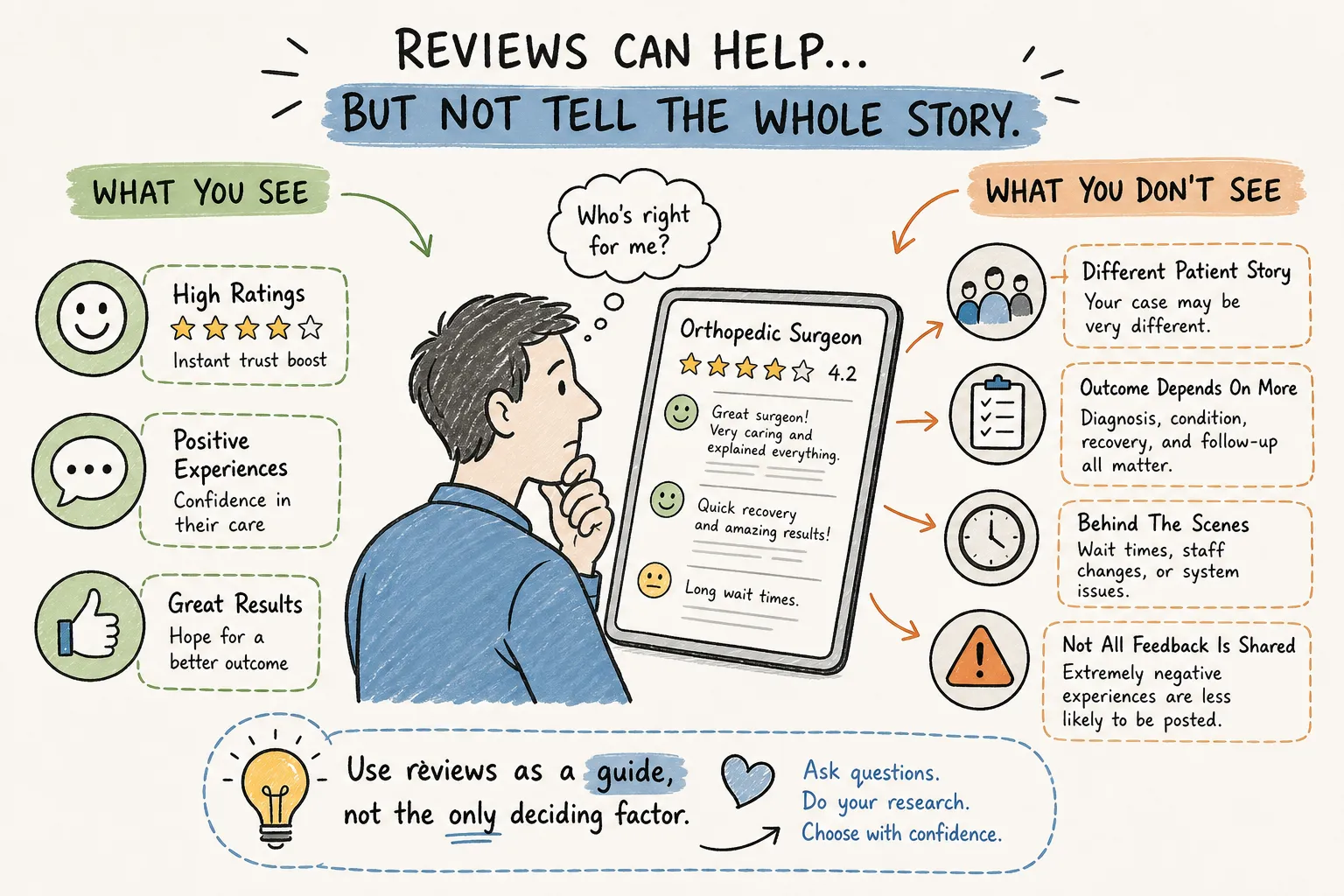
You get a referral, Google your surgeon's name, and within seconds you're staring at a four-star average, two emotional one-liners, and a Healthgrades profile that hasn't been updated in years. The problem isn't a shortage of orthopaedic surgeon reviews. The problem is that many patients misunderstand what those reviews are actually measuring, which ones to trust, and which ones to ignore entirely.
Online ratings can be genuinely useful when you approach them correctly. They can surface real patterns about communication, post-operative support, and patient experience that no credential check will show you. But they can also mislead you if you treat a star average as a proxy for surgical skill. This article walks you through what orthopaedic surgeon reviews actually capture, where to find the most reliable ones, how to interpret ratings without being misled, and the red flags that signal something is off. By the end, you'll have a practical sequence for moving from reading feedback to booking the right specialist.
What orthopaedic surgeon reviews actually measure
Most people read orthopaedic surgeon ratings hoping to find evidence of surgical skill. That's understandable, but it's not what reviews capture, and understanding that gap is the foundation for using them well. This isn't a flaw in the review system; it's simply a reflection of what patients can observe and describe after a procedure.
The topics patients write about most often
Studies of negative orthopaedic surgeon reviews show that bedside manner and communication account for the majority of complaints, appearing in up to 65% of critical feedback, a finding reported across several analyses of surgeon patient reviews in peer-reviewed literature, including research published in journals covering analysis of patient comments on patient-reported outcome measures in orthopaedic trauma. Other frequent themes include pain control, wait times, and whether the surgeon explained the treatment plan clearly. Functional outcomes and recovery do appear in reviews, but less often than you'd expect, because most patients write about how the experience felt rather than a clinical comparison of outcomes.
The gap between patient experience and surgical skill
A surgeon who communicates warmly, runs on time, and makes patients feel heard can still have clinical outcomes worth scrutinising. Conversely, a surgeon with a modest bedside manner may have exceptional complication rates and a flawless technical record. Orthopaedic surgeon reviews capture the experience around the surgery; they rarely capture the surgery itself. That's not a reason to dismiss them. It's a reason to use them alongside other forms of evidence, which later sections cover in detail. A surgeon who dismisses your questions or rushes through appointments is a legitimate concern worth noting, the key is recognising that reviews are one layer of evidence, not the whole picture.
Where to find reliable orthopaedic surgeon ratings
Not all review platforms are built the same way, and the context in which a review appears changes how useful it actually is. Knowing where to look is as important as knowing how to read what you find.
General platforms and their limitations
Google, Healthgrades, WebMD, and RateMDs are the broadest-reach options and the first places most patients land. Google has high visibility but no medical-specific verification process; any account holder can leave a review without confirming they ever attended an appointment, a gap noted in multiple analyses of online doctor review sites for orthopaedics. Healthgrades pulls from government and commercially available data and allows patient satisfaction submissions, but does not verify each review against an appointment record. Most general platforms rely on self-reported, unmoderated feedback, which means the review pool can include former patients, disgruntled one-time visitors, and the occasional submission with a personal agenda.
Zocdoc is a stronger exception here. Because reviews are tied to appointments booked through the platform, there's a direct link between the reviewer and an actual visit, a verification model Zocdoc documents in its platform policies. That appointment-based verification makes Zocdoc-sourced feedback more traceable, even if it's still subject to the usual limits of patient self-reporting.
Why subspecialty context changes everything
The context of a review matters as much as its content. A patient who had ACL reconstruction leaves far more relevant feedback for someone researching knee surgery than someone who had a general joint consultation two years ago. General platforms don't filter for this. They pool feedback from patients with entirely different conditions, procedures, and expectations, which means the aggregate score can be shaped by experiences that have nothing to do with your specific situation.
Specialty directories: a better starting point for WA patients
This is where a platform like Best Orthopaedic Surgeons (BOS) makes a practical difference. BOS is a Western Australian directory dedicated exclusively to orthopaedic surgery, meaning the feedback on each surgeon profile comes from patients who had orthopaedic procedures rather than from a general pool of unrelated comments. According to BOS, the platform is designed to allow filtering by subspecialty and condition, so you can read orthopaedist reviews from other knee patients in Perth or look up shoulder specialists in regional WA before you ever pick up the phone. That subspecialty context is something general doctor review sites for orthopaedics simply don't offer.
How to read orthopaedic surgeon reviews without being misled
Once you're looking at a surgeon's profile, the number you'll see first is an average star rating. It's a useful starting filter, but it can mislead you if you treat it as a precise measurement rather than a rough signal.
Volume and recency: the two metrics most people ignore
A 5.0 from six reviews carries far less statistical weight than a 4.3 from 140 reviews. Small review samples are high-uncertainty estimates. They're more vulnerable to individual extremes, whether that's a single very satisfied patient or one with a grievance. Recency matters for the same reason: a profile loaded with feedback from several years ago may not reflect the surgeon's current practice, waiting times, or support staff. Prioritise profiles with a consistent volume of recent orthopaedic surgeon reviews over those with a perfect score from a handful of older submissions.
What a well-rounded profile actually looks like
A credible profile has a consistent flow of feedback over time, a mix of positive themes like communication and post-operative support, and the occasional honest criticism. Practices that respond to negative feedback professionally and specifically, rather than with generic apologies, signal accountability. That pattern tells you the clinic is engaged with patient experience, not just counting stars. Research on online review behaviour in healthcare settings suggests that response quality and review diversity are among the stronger indicators of profile credibility.
When a lower average outperforms a perfect score
A 4.2 with 200 condition-specific reviews covering multiple procedure types is more useful than a 5.0 from eight reviews that all sound similar. Reliability matters more than perfection. Use the average rating as a first filter to eliminate obvious outliers, then dig into the individual comments to understand what's driving it. A score tells you the temperature; the reviews tell you the story.
Red flags that signal biased or unreliable feedback
Individual reviews can be distorted by any number of factors. What matters is whether a concern appears consistently, with specific detail, across multiple patients and multiple platforms. Learning to recognise patterns is more useful than reacting to any single comment.
Vague praise and scripted-sounding positives
The hallmarks of potentially coached or fake positive reviews are easy to spot once you know what to look for: no specific detail about the procedure, repetitive phrasing across multiple reviewers, and language that sounds like marketing copy rather than a patient account. Genuine orthopaedic surgeon testimonials usually include specifics, the condition treated, what improved, and what recovery actually felt like. If a review could apply to any surgeon in any specialty, it probably tells you very little.
Emotional one-offs versus consistent complaint patterns
One highly emotional negative review written days after surgery deserves less weight than three separate reviews over 18 months all citing the same issue, such as poor follow-up communication or rushed consultations. The former may reflect grief or frustration about outcomes that no surgeon could guarantee. The latter suggests a systemic problem in how the practice operates. The difference matters when you're trying to distinguish between an isolated experience and a genuine pattern of care.
Reviews that reveal nothing about surgical care
Complaints about parking, billing disputes, front-desk staff, or appointment scheduling are real concerns about the practice, but they tell you very little about the surgeon's technical skill or post-operative care. Train yourself to separate practice-experience reviews from surgeon-quality reviews. The former might influence how you feel about booking; the latter is what should influence whether you book at all.
How to use orthopaedic surgeon reviews as part of your selection process
Orthopaedic surgeon feedback is not where your research starts or ends. It's one layer in a multi-step process, and it works best when you combine it with credentials verification, subspecialty matching, and direct consultation.
Layer reviews with credentials verification
Before any review can carry weight, confirm the basics. In Australia, check the surgeon's registration status and qualifications through the Medical Board of Australia's "Look up your doctor" tool, which is publicly available and free. For orthopaedic specialist recognition, verify the FRACS pathway or Royal Australasian College of Surgeons training through the surgeon's profile or the Australian Orthopaedic Association. No volume of positive orthopaedic surgeon ratings replaces confirmed current registration and the right specialist qualifications for your specific procedure.
Match the subspecialty to your specific condition
Matching the surgeon's subspecialty to what you actually need, a spine surgeon for a disc problem, a knee specialist for ACL or cartilage work, a shoulder surgeon for rotator cuff injuries, is the most important selection filter you have. Orthopaedist reviews left by patients with your condition are the most relevant feedback you can find. A general pool of comments from mixed procedures and conditions is far less useful than condition-matched feedback from patients who had the same surgery you're considering.
From review to booking: a practical sequence
This sequence makes the process repeatable and less overwhelming:
- Start with a condition-specific review platform. For patients in Western Australia, Best Orthopaedic Surgeons (BOS) is the purpose-built starting point for orthopaedic surgeon reviews.
- Filter by subspecialty and location to narrow the field to surgeons who treat your condition.
- Look for volume, recency, and specific procedural detail in the reviews before drawing conclusions from the star average.
- Cross-check credentials through the Medical Board of Australia and confirm specialist registration.
- Book your appointment with your GP referral ready, note that booking workflows and referral requirements vary by platform and clinic, so confirm the process directly with the practice once you've made your decision.
Orthopaedic surgeon reviews work best when they're used as a filter, not a final answer. They narrow the field, surface patterns worth investigating, and give you grounded questions to bring to your first consultation. Used alongside credentials checks and subspecialty matching, they're a genuinely valuable part of finding the right orthopaedic surgeon (also referred to as orthopedic surgeon in some sources) for your care in Western Australia.