
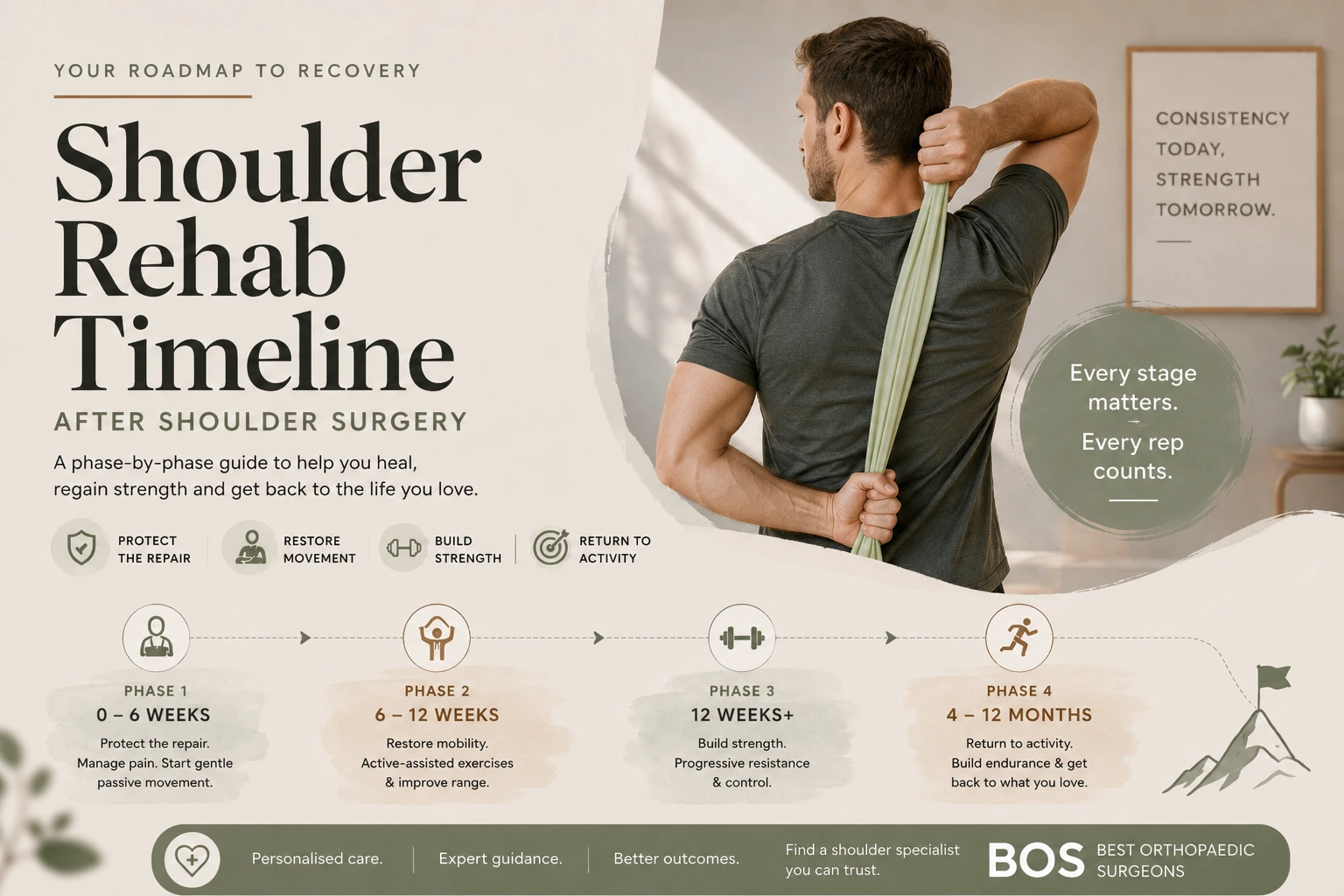

What Does a Shoulder Rehab Timeline Look Like After Surgery?
You come home from hospital with your arm in a sling, a bag of medication, and the feeling that someone should have given you a map.
The operation is complete, but nobody has clearly explained what the next six months will look like. That gap between surgery and full recovery is where many patients feel most uncertain.
This shoulder rehab timeline explains each phase, the milestones clinicians may use to progress the program, and warning signs that warrant contacting your surgeon.
Shoulder recovery follows a structured progression rather than one vague period of healing.
Rotator cuff repair and shoulder replacement move through similar broad rehabilitation phases, but their timing and precautions differ.
The quality of your post-operative guidance is also influenced by the surgeon you choose. Clear discharge instructions, physiotherapy protocols, and structured follow-up can make the recovery process easier to navigate.
Phase 1: The First Four to Six Weeks in a Sling
The main goal during the early phase is protection rather than rapid progress.
The repair needs time to begin healing, and loading it too early can damage the work performed during surgery.
Pain management is a major focus during the first week. The first few nights are often the most difficult until swelling reduces and a comfortable sleeping position is established.
Sleeping in a slightly reclined position with pillows supporting the arm may reduce discomfort.
Rotator Cuff Repair: The Strict Protection Window
A repaired tendon must biologically heal back into the bone. This process cannot be rushed.
Sling use is commonly required continuously for four to six weeks. Large or massive tears may need longer protection, sometimes extending beyond six weeks.
Approved movement during this stage may include:
- Pendulum exercises
- Passive range-of-motion exercises
- Hand and wrist movement
- Gentle elbow movement
- Scapular positioning exercises
Activities commonly restricted include:
- Active lifting of the arm
- Reaching forward
- Overhead movement
- Carrying objects in the operated hand
- Pushing up from a chair with the operated arm
During passive movement, the physiotherapist or unaffected arm moves the shoulder. The repaired rotator cuff is not yet expected to produce the movement independently.
Shoulder Replacement: A Different Early Phase
Shoulder replacement patients may begin passive movement slightly earlier because the prosthetic components are mechanically stable from the day of surgery.
The early concern is focused more on:
- Wound healing
- Avoiding dislocation
- Protecting any repaired tendons
- Following movement precautions
Initial physiotherapy remains gentle and commonly involves slow, therapist-guided movement within approved ranges.
Caregiver support can be especially helpful for dressing, showering, preparing food, household tasks, and transport.
Phase 2: Restoring Movement — Weeks 6 to 12
At approximately six weeks, recovery often begins to feel more active.
Rehabilitation may shift from passive motion to active-assisted motion, where you begin contributing to the movement while still using support from a cane, pulley, wall, table, or unaffected arm.
The eventual goal is active movement controlled entirely by the operated shoulder.
Active-Assisted Exercises Used During Weeks 6 to 12
Exercises may include:
- Wand or cane-assisted elevation
- Overhead pulley exercises
- Table slides
- Wall walks
- Supported external rotation
- Gentle active-assisted reaching
Many programs recommend short sessions two or three times daily, with approximately ten to fifteen controlled repetitions.
Smooth movement is more important than forcing the shoulder towards an aggressive range target.
Consistency matters more than intensity. Missed sessions can allow stiffness to develop, which may be difficult to recover later.
Objective Markers Used Before Progressing
Progression should be based on clinical criteria rather than the calendar alone.
General benchmarks used in some protocols may include:
- Passive forward flexion approaching 130 degrees
- External rotation approaching 30 degrees
- Abduction approaching 60 degrees
- Pain below approximately 4 out of 10 during exercises
- No significant increase in night pain after therapy
- No prolonged symptom flare after exercise
Clinicians also assess movement quality.
Warning signs of poor movement control may include:
- The shoulder hiking towards the ear
- The body leaning to create artificial range
- Excessive scapular winging
- Sudden pain or loss of control
Your treating surgeon and physiotherapist will define the appropriate targets based on the operation and your individual healing.
Phase 3: Strengthening from Twelve Weeks Onward
Formal strengthening commonly begins at approximately twelve weeks after rotator cuff repair, provided adequate healing and range of motion have been achieved.
This is a milestone-based transition rather than an automatic date.
Beginning resistance work before the repair is ready can cause setbacks.
Rotator Cuff Activation and Scapular Stability
Strengthening commonly targets:
- The rotator cuff muscles
- Serratus anterior
- Lower and middle trapezius
- Rhomboids
- Postural muscles
Exercises may include:
- Resistance-band external rotation
- Resistance-band internal rotation
- Scapular retraction
- Supported rows
- Isometric holds
- Wall push-up progressions
Strengthening is commonly completed two or three days per week on non-consecutive days.
A typical starting point may involve several sets of eight repetitions, gradually progressing towards twelve as movement quality and tolerance improve.
Using resistance that is too heavy can create compensatory movement and reduce the benefit of the exercise.
Realistic Progress at Three to Four Months
Rotator cuff repair patients may be managing many activities at shoulder height by three to four months, including:
- Desk work
- Light cooking
- Personal grooming
- Selected household tasks
- Driving after medical clearance
Heavy overhead lifting and sporting activity generally remain restricted.
The shoulder may appear functional while still lacking substantial strength compared with the unaffected side.
Shoulder replacement patients may progress more quickly through basic functional movement, although heavy overhead loading and impact activity may remain restricted long term.
Functional Training and Returning to Activity
From approximately four months onward, the focus shifts from basic strength towards real-world movement.
This may include:
- Pushing
- Pulling
- Lifting
- Reaching overhead
- Work-specific tasks
- Sport-specific movement
Months 4 to 9 After Rotator Cuff Repair
Following a small rotator cuff repair, overhead activity and manual work may begin between four and six months.
Large or massive tears generally require a longer recovery, with return to demanding overhead work or sport often taking nine to twelve months.
Return-to-sport criteria may include:
- Approximately 90% strength compared with the unaffected shoulder
- Full or functional pain-free range of motion
- No visible movement compensation
- Completion of progressive sport-specific loading
- Approval from the treating surgeon and physiotherapist
Swimmers, tennis players, throwing athletes, and tradespeople require the shoulder to tolerate repeated movement, speed, load, and fatigue.
Simply waiting for time to pass is not enough. The shoulder must be progressively trained for the intended activity.
Long-Term Expectations After Shoulder Replacement
Many shoulder replacement patients achieve meaningful functional recovery within three to six months.
Pain may be substantially reduced and routine daily activities may become easier.
Long-term restrictions may apply to:
- Heavy overhead lifting
- Contact sports
- High-impact activities
- Repeated heavy loading
These restrictions are intended to protect the implant and support its long-term durability.
Follow-up appointments may be scheduled at six weeks, three months, twelve months, and periodically after that.
Shoulder Rehabilitation Warning Signs
Slow periods and minor setbacks can occur during recovery, but some symptoms require direct medical review.
Warning Signs During the First Weeks
Contact your surgeon or healthcare team if you experience:
- Increasing redness around the wound
- Increasing warmth or swelling
- Discharge from the wound
- Fever
- Sudden or unexplained worsening of pain
- New numbness, tingling, or burning
- Unexpected loss of arm control
- A feeling that the shoulder has shifted or dislocated
These symptoms should not be managed solely with rest and ice without seeking advice.
Longer-Term Signs That Recovery Has Stalled
Seek medical review when:
- Range of motion has stopped improving despite regular physiotherapy
- Pain is increasing rather than gradually improving
- The shoulder feels unstable
- Weakness remains unexpectedly severe
- The original symptoms return
- Clicking, catching, or locking becomes persistent
- Nerve symptoms continue without improvement
A recovery plateau lasting more than two or three weeks may warrant discussion with the treating surgeon.
Frozen shoulder is also a risk when movement fails to progress, particularly if physiotherapy is stopped or the arm is avoided entirely.
Why the Surgeon You Choose Shapes the Rehabilitation Experience
The surgeon's influence does not end when the operation is complete.
Rehabilitation is shaped by:
- The surgical technique
- The post-operative protocol
- The clarity of discharge instructions
- Communication with the physiotherapist
- The timing of follow-up appointments
- The surgeon's response to setbacks
Patients who leave hospital with a written rehabilitation protocol and clear restrictions are better prepared than those who receive only general verbal advice.
Early follow-up can also help identify infection, stiffness, movement problems, or unexpected complications before they become more difficult to manage.
Finding a Shoulder Surgeon in Western Australia
Best Orthopaedic Surgeons (BOS) is a dedicated orthopaedic directory for Western Australian patients.
Patients can:
- Search by shoulder subspecialty
- Filter by location
- Review surgeon profiles
- Read patient feedback
- Find clinic and hospital affiliations
- Ask questions through available profile features
Search locations may include Perth, Fremantle, Bunbury, Geraldton, and surrounding regional areas.
Your Recovery Roadmap, One Phase at a Time
The shoulder rehab timeline follows a clear structure:
- Weeks 0 to 6: Protect the repair and prevent excessive stiffness.
- Weeks 6 to 12: Restore movement through passive and active-assisted exercise.
- From 12 weeks: Begin progressive strengthening when appropriate.
- Months 4 to 12: Rebuild full function for daily activity, work, and sport.
Progression between phases should be based on range of motion, pain levels, strength, movement quality, and the type of surgery performed.
Ask your surgeon and physiotherapist:
- Which milestone must I reach before progressing?
- What are my current range-of-motion measurements?
- What movements remain restricted?
- When can strengthening safely begin?
- What is the realistic timeline for my specific repair?
If you are choosing a surgeon or considering a second opinion, find a verified shoulder specialist through BOS.