
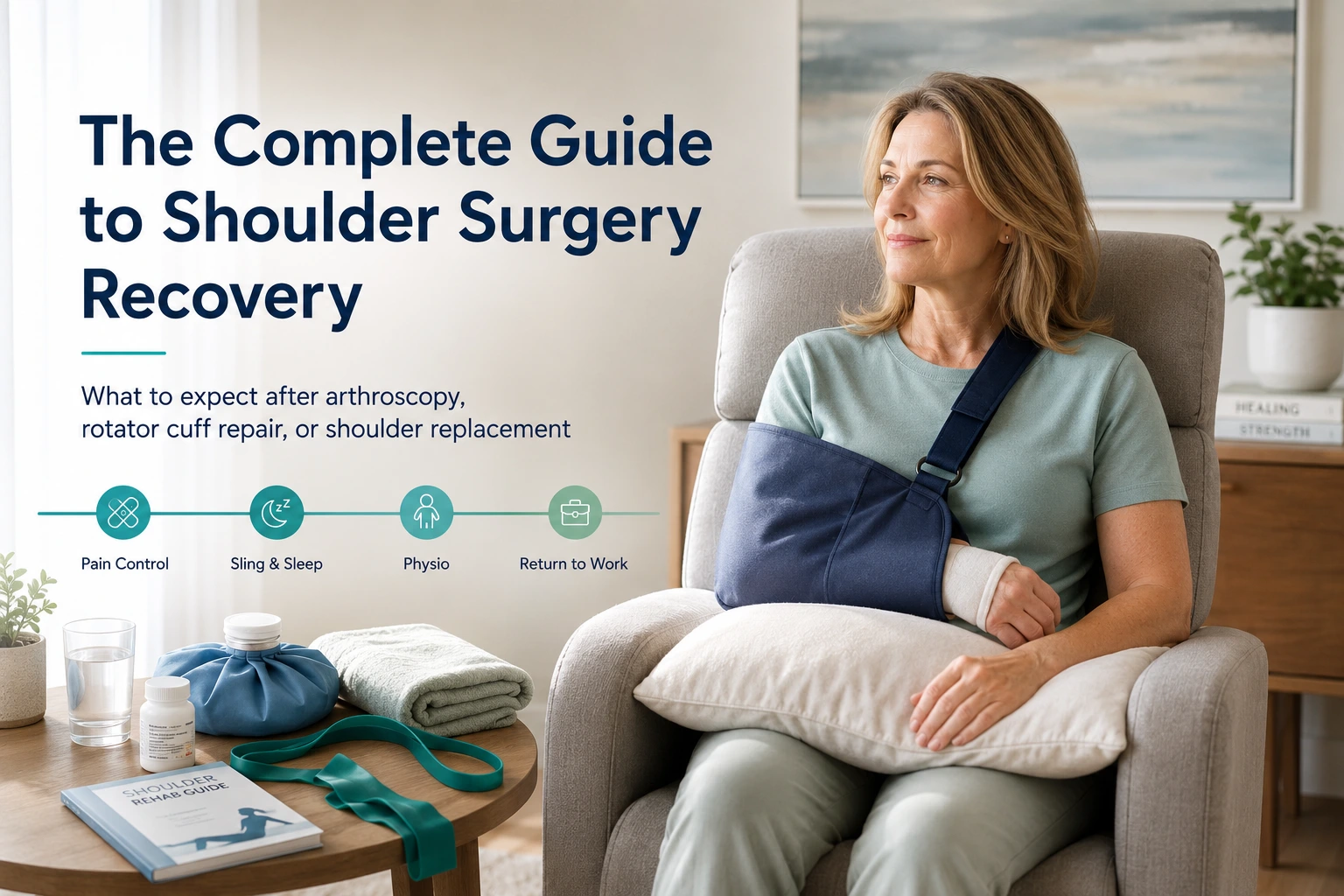

The Complete Guide to Shoulder Surgery Recovery
Recovery after shoulder surgery often takes longer than patients anticipate. That gap between expectation and reality is one of the main reasons the process can feel harder than it needs to be.
Many patients receive only a brief pre-operative explanation. Once you're home with your arm in a sling, a stiff shoulder, and nights you cannot sleep through, a basic discharge sheet may not feel like enough. This guide fills that gap.
Shoulder surgery recovery looks different depending on what was repaired. A straightforward shoulder arthroscopy, a rotator cuff repair, and a total shoulder replacement follow different timelines, rehabilitation protocols, and expectations for pain, mobility, work, and sport.
Knowing which path you're on changes how you prepare. Preparation also begins before the operation by choosing a surgeon whose approach to post-operative care matches your needs. Best Orthopaedic Surgeons (BOS) helps Western Australian patients find shoulder specialists and review information relating to communication and recovery support.
How Long Does Shoulder Surgery Recovery Take?
The honest answer is usually longer than the optimistic timeline shown in many brochures.
Recovery depends on:
- The procedure performed
- The size and complexity of the injury
- The quality of the repaired tissue
- Your overall health and age
- How closely you follow the rehabilitation plan
- The physical demands of your work and sport
Rotator Cuff Repair: A Four-to-Twelve-Month Journey
Rotator cuff repairs are not all the same. Tear size is one of the most important predictors of recovery length.
- Small tears: Full recovery may take approximately four months.
- Large tears: Recovery often takes closer to six months.
- Massive or severely degenerated tears: Strength and function may take six to twelve months to return.
At six weeks, the repaired tendon is still bonding to the bone and remains vulnerable. At approximately three months, active movement and light strengthening may begin, depending on the surgeon's protocol.
By six months, many patients regain enough function for routine daily activities. Strength and overhead endurance may continue improving after this point, particularly following larger repairs.
Shoulder Arthroscopy Recovery and Why the Procedure Matters
Arthroscopy describes the surgical method rather than one specific operation. A shoulder debridement and a labral repair may both be performed arthroscopically, but they have very different recovery timelines.
Simpler procedures such as subacromial decompression may show meaningful functional improvement within six to eight weeks.
A labral stabilisation repair is usually managed more cautiously. Restrictions may remain in place for approximately three months, while full recovery after a complex repair can take up to twelve months.
Many shoulder arthroscopy patients experience substantial improvement by three months and approach full recovery by six months. More complex repairs should be planned around the longer end of the expected range.
Shoulder Replacement Recovery
Total and reverse shoulder replacements generally follow a slow but steady recovery trajectory.
- Around six weeks: Active movement work may begin.
- Around three months: Many routine daily functions are restored.
- Three to six months: Strength and endurance continue improving.
- Up to twelve months: Maximum recovery may be reached.
Reverse shoulder replacement is often used for more complex conditions, including massive rotator cuff tears combined with arthritis. Its recovery follows a similar general pattern but may require a more gradual early phase.
Pain Control During the First Weeks
Pain after shoulder surgery is real. Managing it effectively during the early weeks protects both your comfort and your ability to participate in rehabilitation.
Modern pain management is usually multimodal, meaning several methods are combined rather than relying on one medication.
The First 48 Hours and the Effect of a Nerve Block
Many shoulder operations use an interscalene nerve block. This numbs the shoulder and arm for approximately twelve to twenty-four hours after surgery.
The block can be very effective, and some patients feel surprisingly comfortable after waking. The challenge begins when it wears off.
Pain may increase significantly as sensation returns, particularly if the patient has not taken prescribed medication before the block completely fades.
Practical preparation includes:
- Taking medication according to the prescribed schedule
- Not waiting until pain becomes severe before using approved medication
- Preparing an ice pack or cold-compression device
- Having the sling fitted and ready
- Knowing who to contact if pain remains uncontrolled
Non-Opioid Pain Strategies
Paracetamol and anti-inflammatory medicines such as ibuprofen commonly form the foundation of post-operative pain management when they are medically appropriate.
These may be used in a layered schedule throughout the day to maintain a manageable level of comfort.
Ice is also important. Applying cold for approximately fifteen to twenty minutes at a time, several times daily, may reduce swelling and pain.
Cold-compression devices can provide additional support during the first two weeks.
Opioid medication may have a short-term role for severe breakthrough pain, but it can cause drowsiness, constipation, nausea, impaired driving ability, and dependency when used longer than necessary.
Always follow your surgeon's medication plan and do not start, stop, or change prescribed medication without medical advice.
Sleep Positioning During Shoulder Recovery
Poor sleep is one of the most frequent complaints during the first one to three weeks.
Sleeping flat on your back with the arm unsupported can place uncomfortable tension through the shoulder.
A more comfortable setup may include:
- Sleeping in a recliner
- Using a wedge pillow to remain elevated at approximately 45 degrees
- Placing a small pillow behind the elbow
- Keeping the arm supported so it does not pull on the repair
- Wearing the sling during sleep when instructed
Your surgeon's specific instructions should take priority because sling and sleeping requirements vary by procedure.
How Long Will You Need a Sling?
The sling is one of the most frustrating parts of shoulder surgery recovery, but it serves an important purpose.
It protects healing tissue from active loading and prevents sudden movements that could damage the repair.
Typical Sling Duration After Shoulder Surgery
- Rotator cuff repair: Commonly four to six weeks.
- Large or massive rotator cuff repair: Protection may extend beyond six weeks and occasionally up to twelve weeks.
- Arthroscopic stabilisation: Commonly two to six weeks depending on the repair.
- Total shoulder replacement: Often four to six weeks.
- Reverse shoulder replacement: Sometimes six to eight weeks.
These are general ranges. Tissue quality, tear size, surgical technique, and the exact procedure determine what your shoulder can safely tolerate.
What You Can and Cannot Do While Wearing a Sling
Many surgeons allow the sling to be removed for:
- Showering and hygiene
- Approved physiotherapy exercises
- Hand, wrist, and elbow movement
- Specific tasks authorised by the treating team
The sling does not necessarily mean complete inactivity. Its purpose is to prevent the repaired shoulder from carrying an unsafe load.
Driving is generally unsafe while wearing a sling. Opioid medication can also make driving unsafe regardless of whether the sling has been removed.
Arrange transport, household support, and work adjustments before surgery rather than waiting until you return home.
Your Physiotherapy Roadmap from Week One to Month Six
Shoulder rehabilitation generally follows three principles:
- Protect the repair.
- Restore movement.
- Rebuild strength.
Phase 1: Protecting the Repair and Preventing Stiffness — Weeks 0 to 6
The first six weeks are not about pushing aggressively. They are about protecting healing tissue while preventing unnecessary stiffness.
Physiotherapy may begin within the first one to two weeks and commonly includes:
- Pendulum exercises
- Passive shoulder movement
- Hand and wrist exercises
- Elbow mobility
- Gentle scapular setting
During passive movement, the operated shoulder is moved by the physiotherapist, gravity, or the unaffected arm. The repaired shoulder is not yet expected to lift itself.
Tendon-to-bone healing follows a biological timetable that cannot be accelerated by exercising harder. Loading the repair too early may cause failure.
Phase 2: Restoring Motion — Weeks 6 to 12
Around the six-week mark, many patients begin moving from passive exercises to active-assisted movement.
Exercises may include:
- Wall walks
- Pulley exercises
- Cane-assisted elevation
- Table slides
- Supported external rotation
- Gentle isometric muscle activation
You begin contributing more actively to the movement, although the shoulder remains supported.
The shoulder may begin to feel functional again but can still fatigue quickly. Consistent daily movement is important for preventing stiffness.
Phase 3: Building Strength — Months 3 to 6
Resistance exercises commonly begin between three and six months, depending on the procedure and whether adequate healing and range of motion have been achieved.
Strengthening may include:
- Resistance-band rotation
- Supported rowing
- Scapular retraction
- Serratus anterior strengthening
- Side-lying external rotation
- Light weight training
Strength sessions are commonly completed every other day or approximately three times per week, while range-of-motion work may continue daily.
Strength recovery usually lags behind pain relief. You may feel substantially better at three months while still tiring quickly during activity.
Endurance develops gradually through months four to six. Consistency matters more than intensity.
Returning to Driving, Work, and Sport
Return-to-activity timing depends on the surgery, the operated arm, medication use, job requirements, and progress in physiotherapy.
Driving and Desk Work
After a minor arthroscopic procedure, driving may be considered after one to two weeks in selected cases, provided you:
- Are no longer taking sedating medication
- Are no longer restricted by the sling
- Can control the steering wheel safely
- Can react quickly during an emergency
- Have been cleared by your surgeon
Following rotator cuff repair, many surgeons advise waiting approximately four to six weeks.
Desk work may be possible within one to two weeks after simpler procedures and approximately two to six weeks after more complex repairs.
Manual Labour and Overhead Work
Light manual tasks may become possible at approximately six to eight weeks.
Heavy lifting, repetitive overhead work, construction, warehousing, and trade work commonly require at least three to four months after rotator cuff repair.
Full work capacity may take four to six months or longer.
Discuss temporary duties, reduced hours, and workplace restrictions with your employer before surgery.
Returning to Sport
Contact sport, throwing, swimming, tennis, and overhead athletic activity may require six to twelve months.
Clearance is generally based on:
- Near-full strength compared with the unaffected side
- Full or functional range of motion
- No pain during sport-specific movement
- Good shoulder and scapular control
- Completion of progressive loading exercises
- Approval from both the surgeon and physiotherapist
Why Your Choice of Surgeon Shapes the Recovery
The operation receives most of the attention, but recovery is where much of the final outcome is determined.
The surgeon's role extends beyond the operating theatre and includes:
- Choosing the surgical technique
- Creating the pain-management plan
- Providing sling instructions
- Defining movement restrictions
- Coordinating physiotherapy
- Monitoring progress during follow-up
- Responding to complications or unexpected symptoms
A technically skilled surgeon who provides unclear post-operative instructions can leave patients anxious about what they can safely do.
Clear recovery communication is part of good clinical care, not an optional extra.
How BOS Helps Patients Find a Shoulder Specialist
Best Orthopaedic Surgeons is a Western Australian directory focused specifically on orthopaedic care.
Patients can use BOS to:
- Search by shoulder subspecialty
- Filter by condition treated
- Compare surgeon profiles
- Review clinic and hospital locations
- Read patient feedback
- Find specialists across Perth and regional WA
Patient reviews mentioning pain support, communication, follow-up, and rehabilitation guidance may provide insight that professional qualifications alone cannot show.
Shoulder Surgery Recovery Is More Predictable When You Know What to Expect
Shoulder surgery recovery usually follows a recognisable sequence: protect the repair, restore movement, and rebuild strength.
Recovery may take approximately four months for a small rotator cuff tear and up to twelve months for a massive tear or complex shoulder replacement.
With an appropriate multimodal plan, pain can be controlled. With timely physiotherapy, stiffness can be reduced. With the right sleeping position, early-night discomfort may become more manageable.
Patients who understand what the six-week and three-month milestones involve are often better prepared for the slow periods of recovery.
If you're choosing a surgeon or preparing for an operation, search for a shoulder specialist in Western Australia through BOS.