

The moment your surgeon tells you that you need a shoulder replacement, the questions come fast. How long will you be in hospital? When can you actually drive again? What does physiotherapy look like in Perth, and how long before you can use your arm normally? This shoulder replacement surgery recovery guide for Perth patients answers those questions clearly, because the details matter more than most people realise before going into theatre.
Before you even book a consult, many Perth patients use Best Orthopaedic Surgeons (BOS) to read patient reviews about post-operative experiences with specific shoulder surgeons in Western Australia. That research is worth doing before your procedure, not after, because recovery expectations vary significantly between surgeons and surgical approaches.
This guide covers your hospital stay at a Perth facility, pain management at home, the staged physiotherapy timeline, when you can return to driving and work, and the warning signs you should never ignore.
What to expect from your WA hospital stay
How long Perth patients typically stay, shoulder replacement recovery guide
For shoulder replacement surgery at Perth hospitals, the standard stay is typically one to three nights depending on the facility, surgical complexity, and whether you are on a public or private pathway. Private facilities such as Hollywood Private Hospital and Mount Hospital generally discharge patients the morning after surgery if recovery is progressing well. Joondalup Health Campus, a public tertiary hospital with some private arrangements, and public hospitals such as Royal Perth Hospital may retain patients for two to three nights depending on medical complexity and social support at home.
Your first 24 to 48 hours after surgery
Immediately after surgery, your shoulder is fitted into a sling and pain management begins in the operating theatre. Most Perth anaesthetists use an interscalene brachial plexus block. A single-shot block typically provides strong pain relief for four to eight hours, while a continuous catheter can extend that coverage into the first 24 to 48 hours. Alongside the nerve block, your team will start scheduled paracetamol and an anti-inflammatory if appropriate, with opioids reserved for breakthrough pain. Your ward physiotherapist will visit early to encourage gentle hand, wrist, and elbow movements, which protect against stiffness and swelling without loading the shoulder joint.
What you'll be sent home with
Your discharge pack will typically include several important items to review before you leave the ward:
- A sling protocol tailored to your specific procedure (rules differ between total and reverse shoulder replacement)
- Written wound care instructions
- Oral medications, typically paracetamol, a short course of anti-inflammatories, and a limited opioid supply for breakthrough pain
- A follow-up appointment already booked with your Perth shoulder surgeon
Read everything in your discharge pack before you leave the ward, because the sling and activity rules differ between total and reverse shoulder replacement.
Perth shoulder replacement recovery timeline: week 1 to 12 months
The first six weeks: protection comes first
Weeks zero to six are the protection phase for both total anatomic and reverse shoulder replacement. Sling use is strongly recommended throughout this period, follow your surgeon's specific protocol, as duration and purpose can vary by procedure type and individual factors. Daily activity is limited to light tasks such as lifting a cup or eating with the arm held close to the body. No pushing, pulling, lifting, overhead movement, or sudden shoulder actions. Pain and swelling peak in the first 72 hours and then gradually settle, but the underlying tissue repair is still fragile well beyond that point. This is not the time to test your limits.
Weeks 6 to 12: rebuilding range of motion
At the six-week mark, your surgeon will typically reduce or remove sling requirements and introduce active shoulder movement for the first time. The focus shifts from protecting the repair to regaining controlled motion. Light strengthening usually does not begin until weeks eight to twelve, and only when your surgeon has reviewed your progress and given explicit approval. Reverse shoulder replacement patients often move through this window slightly more conservatively than anatomic total shoulder replacement patients, because the risk profile for complications differs between the two designs.
Three months to one year: strength, endurance, and function
From the three-month mark, progressive strengthening of the shoulder muscles and scapular control becomes the primary focus of rehabilitation. Most Perth patients are managing the majority of daily tasks independently by the four to six month mark. Strength and endurance continue improving through nine to twelve months, particularly for reverse shoulder arthroplasty patients. Expecting a complete recovery by eight weeks is one of the most common misunderstandings Perth patients bring to their post-op appointments. This is a twelve-month journey.
Managing pain at home after shoulder arthroplasty
What your pain control plan will look like
The multimodal approach used in Perth hospitals carries directly into your first days at home. Scheduled paracetamol forms the backbone of your home pain regimen, taken at regular intervals rather than only when pain spikes. NSAIDs such as ibuprofen or celecoxib are added if there are no contraindications including kidney disease, stomach ulcers, or cardiovascular risk. Opioids like oxycodone are typically prescribed for breakthrough pain only and phased out quickly, usually within the first one to two weeks at home. For clinicians and patients wanting a deeper look at perioperative analgesia approaches, see this review of pain management strategies in shoulder arthroplasty.
Practical home strategies that actually help
Ice or cryotherapy applied to the shoulder reduces post-operative swelling and lowers the amount of pain medication you need, particularly in the early weeks after discharge. Apply it for fifteen to twenty minutes at a time, several times a day, with a cloth barrier between the ice and your skin. Sling compliance is not optional at this stage: removing it early is one of the most common reasons patients end up back in their surgeon's office with a complication. Sleep position matters too. Many Perth shoulder surgeons recommend sleeping semi-reclined, either in a recliner chair or propped up with pillows, for the first few weeks, as this can reduce overnight pressure and morning stiffness. Check your discharge instructions or confirm this with your surgeon, as recommendations vary.
Perth physiotherapy, recovery guide for shoulder replacement patients
When physio starts and what the early phase looks like
Physiotherapy typically begins within the first one to two weeks after discharge. Early sessions focus on protecting the joint while maintaining mobility in the hand, wrist, and elbow. Common early exercises include hand open-and-close squeezes, wrist flexion and extension, elbow bending, gentle shoulder blade squeezes, and pendulum movements if cleared by your surgeon. Perth has a strong network of physiotherapy clinics with post-surgical shoulder experience. For patients who cannot travel in the early weeks, mobile physio services such as Physio Inq South Perth offer home visits specifically suited to early post-operative care. For practical tips on staged rehabilitation and home exercises, see these tips for recovery and rehabilitation after shoulder replacement.
Milestones your physio will work toward
Your rehabilitation follows a phase-based progression anchored to your surgeon's specific protocol. Passive and assisted motion is the focus from weeks one to six. Active range of motion is introduced from week six onward. Light resistance work begins around weeks ten to twelve, once your surgeon confirms the repair is ready for loading. Progressive functional strengthening starts from three months and continues well into the second half of the year. One critical point: total shoulder replacement and reverse shoulder replacement carry different exercise restrictions and timelines, so following a generic online program rather than your surgeon's actual protocol is a genuine risk. Evidence-based guidance on rehabilitation progressions supports phase-based protocols like these, as outlined in the literature on shoulder arthroplasty rehabilitation (clinical rehabilitation recommendations).
Returning to driving, work, and daily life in Perth
Driving and desk work: the timelines to know
Perth patients are typically cleared to drive at around the six-week mark, once they are out of the sling and their surgeon has assessed their ability to control a vehicle safely. In Western Australia, there is no specific law setting a post-surgical waiting period for private drivers, but you must be medically fit to drive, free of sling use, free of pain medication impairment, and capable of steering and reacting safely. Driving while in a sling or on opioid medication can void your insurance cover if you are involved in an accident, so get written clearance from your surgeon before getting behind the wheel. Returning to desk or sedentary work is often possible from two to three weeks post-surgery, provided pain is managed and the sling does not interfere with your work setup.
Manual work, lifting, and active hobbies
Return to manual or physically demanding work typically falls between three and nine months post-surgery, depending on the nature of the role, the type of replacement performed, and your physiotherapy progress. Overhead activity and lifting restrictions extend to at least six weeks for both surgical types. For active Perth patients looking to return to recreational sport or fitness training, this timeline is worked out directly with both your surgeon and physiotherapist based on your individual recovery. There is no universal answer: your specific implant, tissue quality, and rehab compliance all feed into the decision.
Warning signs and choosing the right Perth shoulder surgeon
Complications to take seriously
Most shoulder replacements in Perth proceed without serious complications, but there are specific warning signs that require an urgent call to your surgeon or a presentation to a Perth emergency department. Watch for increasing redness, warmth, or discharge at the wound site, which may indicate infection. A fever above 38 degrees Celsius is another red flag, particularly when combined with wound changes. New or worsening pain beyond what you would expect at that stage of recovery, numbness or weakness in the hand or arm, and any sudden loss of shoulder movement that was previously improving should all be treated as urgent. Do not wait for your next scheduled appointment if you notice these signs.
Using patient reviews to choose the right Perth shoulder surgeon
Best Orthopaedic Surgeons (BOS) is a WA-focused orthopaedic directory built specifically for patients in Western Australia. You can search for shoulder replacement specialists by subspecialty and location across Perth and regional WA, read patient reviews focused on post-operative care, communication quality, and recovery support, and submit questions directly through surgeon profile pages before you book your first consult. Unlike broad health directories, BOS filters by orthopaedic subspecialty so you are comparing surgeons who specifically perform shoulder arthroplasty, not general practitioners or unrelated specialists. For anyone still deciding on a Perth shoulder surgeon, BOS is a practical and focused starting point for WA patients researching their options.
The recovery journey is staged, not sudden
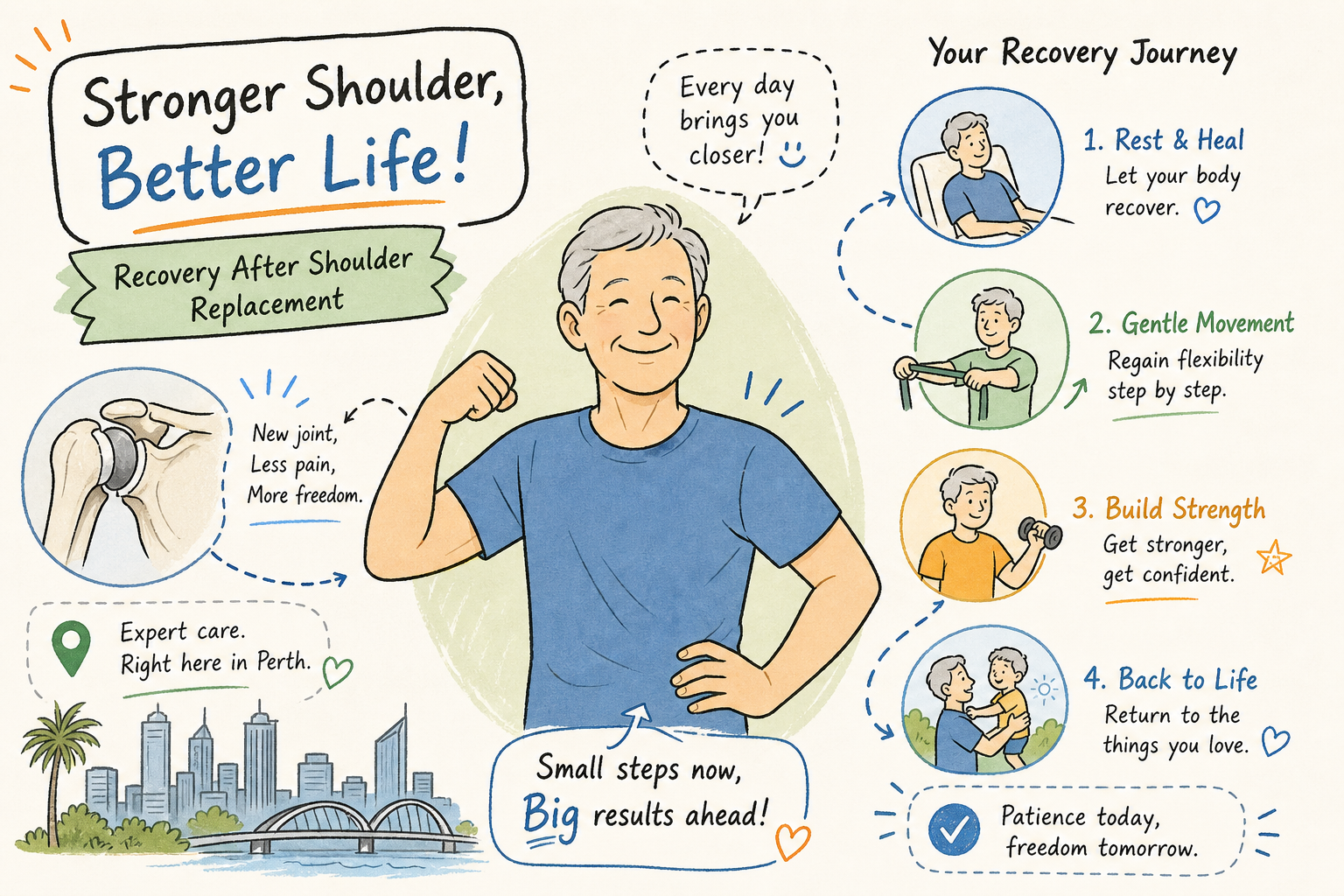
Shoulder replacement recovery follows a clear and manageable arc: one to three nights in hospital, six weeks of sling use and protection, gradual active motion from week six, light strengthening from weeks ten to twelve, progressive functional work from three months, and continued strength and endurance gains through twelve months. Both total and reverse shoulder replacement follow this broad progression, with the reverse pathway typically being slightly more conservative in the early phase. Major centres publish recovery guidance consistent with this staged approach (Mass General recovery guidance).
The most practical takeaways are these: follow your surgeon's specific protocol rather than generic advice from the internet, start physiotherapy early and attend consistently, respect the sling and driving timelines because they exist for clinical reasons, and take the warning signs covered above seriously. Early rehab adherence and close follow-up with your surgical team are among the strongest factors influencing your long-term outcome, alongside surgical technique, implant type, and your overall health.
If you are still in the process of choosing a surgeon, this shoulder replacement surgery recovery guide for Perth patients is a useful starting point, but pairing it with direct research through Best Orthopaedic Surgeons (BOS) gives you real patient perspectives on post-operative care from surgeons across Western Australia. Going into surgery with a clear picture of your surgeon's recovery approach means fewer surprises and a more confident recovery. For a complete shoulder replacement surgery recovery guide tailored to Perth patients, review your surgeon's protocol and explore BOS listings before you book your consult.