
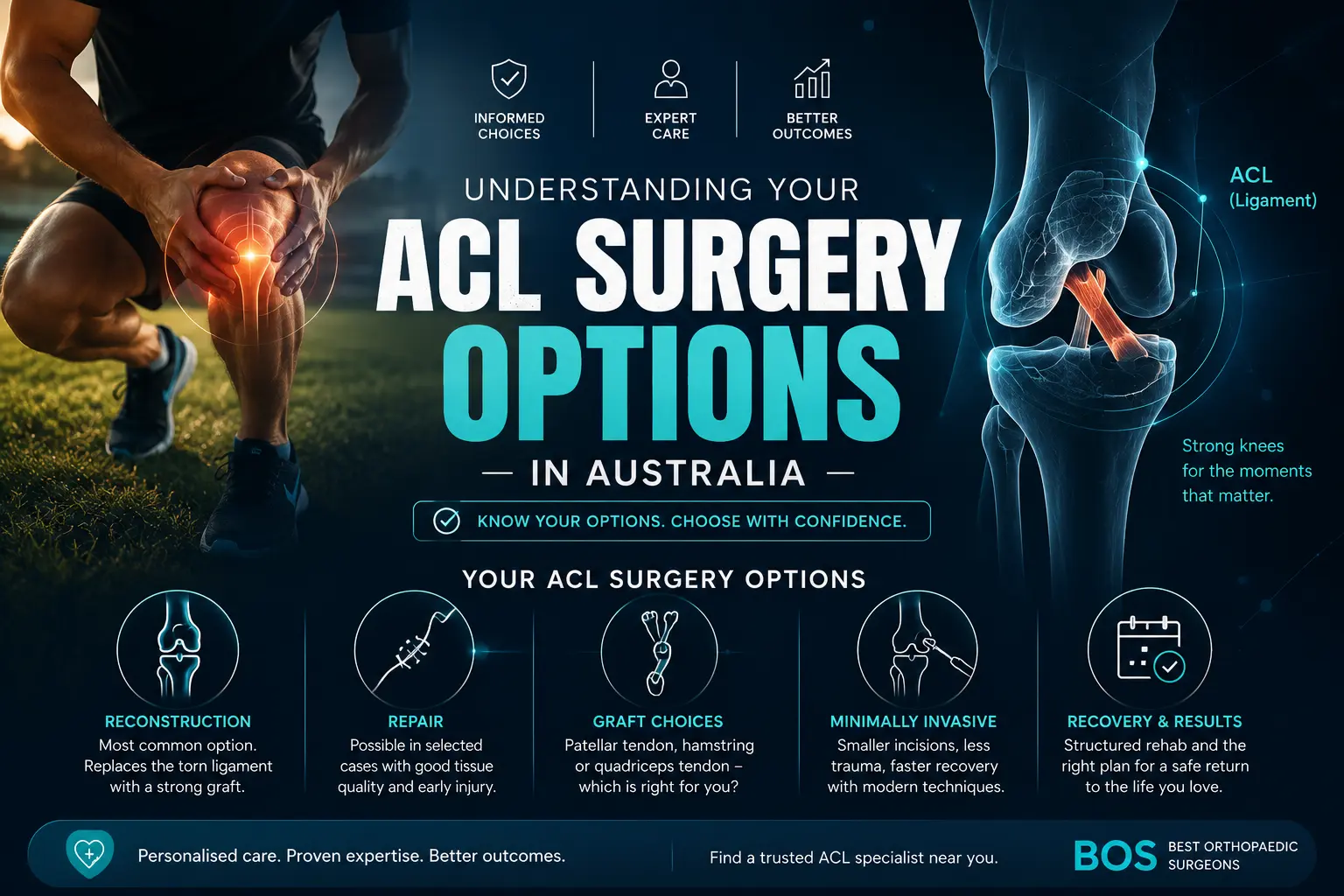

Understanding Your ACL Surgery Options in Australia
If you're weighing up your ACL surgery options after a recent tear, you're probably facing more confusion than clarity. ACL tears are among the most common serious knee injuries seen in Australian sporting populations, affecting everyone from weekend AFL players to competitive soccer athletes.
Yet many patients leave their initial diagnosis without a clear picture of why multiple treatment pathways exist or what the differences mean for their knee, sport, and recovery.
This article explains what you need to know before entering a surgeon's consulting room. You'll learn how ACL reconstruction differs from repair, why graft choice matters, what minimally invasive surgery means in practice, and what a realistic recovery timeline looks like.
Understanding your ACL surgery options is the first step. Finding the right specialist to guide you through them is the second, and that is exactly what Best Orthopaedic Surgeons (BOS) is designed to help Western Australian patients do.
ACL Surgery Options: Reconstruction vs Repair
The first question many ACL patients ask is whether the ligament needs to be replaced or whether it can simply be stitched back together.
The answer largely comes down to biology. After an ACL tear, tissue quality can deteriorate and the ligament may have limited ability to heal reliably. For many patients, there is not enough healthy tissue remaining to create a repair that will withstand normal movement and sporting loads.
ACL reconstruction replaces the torn ligament with a tendon graft. The body gradually incorporates and remodels this graft over several months through a process known as ligamentisation.
When Primary ACL Repair May Be Considered
Primary ACL repair involves suturing the torn ligament back into place rather than replacing it with a graft.
It may be considered for a narrow group of patients when:
- The injury is recent, generally within approximately four weeks.
- The tear is located near the femoral or upper attachment of the ligament.
- The remaining ligament tissue is healthy enough to hold sutures.
- There is limited associated meniscal or cartilage damage.
- The injury is a proximal avulsion tear with an intact surrounding sheath.
Mid-substance tears, longstanding injuries, poor tissue quality, and injuries in high-demand pivoting athletes are less likely to be suitable for primary repair.
Your surgeon will use your MRI, physical examination, injury timing, and activity goals to determine whether repair is a realistic option.
Who Is Best Served by ACL Reconstruction?
ACL reconstruction remains the standard surgical approach for most patients because it provides predictable stability and is supported by decades of clinical outcome data.
Reconstruction may be particularly appropriate for patients who:
- Experience repeated knee instability or giving way
- Want to return to pivoting or contact sport
- Have an associated meniscal injury
- Perform physically demanding work
- Are young and highly active
- Have not achieved sufficient stability through rehabilitation
A smaller group of lower-demand patients with a stable knee may manage the injury through structured physiotherapy without surgery.
However, repeated instability can increase the risk of secondary meniscal and cartilage damage over time. The appropriate choice depends on how the knee performs during real movement, not only how the injury appears on a scan.
ACL Graft Choices for Reconstruction
Once reconstruction has been recommended, graft selection becomes the next important decision.
An autograft uses tendon taken from your own body. The three most common sources are:
- Patellar tendon
- Hamstring tendons
- Quadriceps tendon
Each graft involves different trade-offs relating to strength, healing, incision location, muscle function, and discomfort at the harvest site.
The best option depends on your age, activity level, sport, occupation, anatomy, previous surgery, and the technique your surgeon performs most consistently.
Patellar Tendon Graft: The Bone-to-Bone Advantage
A bone-patellar tendon-bone graft uses the middle portion of the patellar tendon with a small piece of bone taken from the kneecap and the upper shin bone.
This graft has a long history in ACL reconstruction and provides bone-to-bone fixation at both ends of the graft. This can support reliable integration within the bone tunnels.
Patellar tendon grafts are often considered for high-demand athletes because they have shown low retear rates in many large outcome studies.
Potential trade-offs include:
- Anterior knee pain
- Discomfort when kneeling
- Numbness around the incision
- Pain at the tendon harvest site
- A small risk of patellar fracture or tendon injury
This graft may be less appealing for people whose work or lifestyle involves frequent kneeling.
Hamstring Tendon Graft: Less Anterior Knee Pain, Different Trade-Offs
Hamstring grafts commonly use tendons taken from the inner side of the thigh.
They generally produce less kneeling pain than patellar tendon grafts and are harvested through a smaller incision.
They may be suitable for patients who want to avoid anterior knee discomfort or who kneel regularly for work, sport, or daily activities.
Potential disadvantages include:
- Early hamstring weakness
- Temporary effects on sprinting and cutting strength
- Variation in graft size between patients
- A potentially higher failure risk when the harvested graft is small
- A slightly higher retear risk in some young, highly active populations
Your surgeon may assess tendon size, age, body size, sport, and reinjury risk when deciding whether a hamstring graft is appropriate.
Quadriceps Tendon Graft: An Increasingly Popular Middle Ground
The quadriceps tendon provides a thick and strong graft while preserving the hamstring tendons.
It may be harvested with or without a small bone block. Growing clinical evidence supports stability and functional results comparable to other commonly used autografts.
Potential advantages include:
- A large and predictable graft size
- Preservation of hamstring function
- Less kneeling sensitivity than some patellar tendon grafts
- Suitability for selected revision procedures
- Usefulness in larger or high-demand patients
The main short-term trade-offs are quadriceps weakness and delayed muscle activation during early rehabilitation.
Quadriceps tendon graft use has become increasingly common in Australian orthopaedic practice, particularly when graft size and strength are important considerations.
Autograft vs Allograft: How Age and Activity Level Change the Decision
An autograft uses your own tendon. An allograft uses donor tissue.
Allografts avoid the need to harvest one of your own tendons, which can reduce pain and weakness at the donor site and shorten the operative procedure.
However, graft selection should not be based on convenience alone. Age, sporting goals, biological healing, and reinjury risk need to be considered carefully.
Why Allografts Carry a Higher Failure Risk in Active Patients
In younger and highly active patients, donor grafts have shown higher failure rates than autografts in several studies.
Some research has reported that the risk of allograft rupture in active populations may be several times higher than the risk associated with an autograft.
Adolescents and young adults returning to sports involving cutting, pivoting, and contact appear to face the greatest difference in risk.
Possible reasons include:
- Slower biological incorporation of donor tissue
- Differences in graft processing and sterilisation
- Higher sporting loads in young patients
- Earlier exposure to high-risk movements
For patients under 30 who want to return to pivoting sport, an autograft is commonly preferred.
When Donor Tissue May Be a Reasonable Consideration
The difference in failure risk between autograft and allograft generally becomes smaller as age increases and sporting demands decrease.
An allograft may be discussed for selected patients over approximately 30 to 35 years of age who are not returning to competitive pivoting sport.
It may also be considered in certain revision procedures or situations where harvesting the patient's own tendon is not appropriate.
The discussion should be based on your real activity goals rather than a general assumption about what someone of your age usually does.
Minimally Invasive ACL Surgery and What It Means in Practice
The phrase "minimally invasive" is sometimes used as though it refers to a premium or unusual form of ACL surgery.
In modern Australian orthopaedic practice, most ACL reconstruction procedures are already performed using arthroscopic techniques.
Arthroscopic ACL Reconstruction as the Current Standard
Arthroscopic surgery uses several small incisions, a camera placed inside the knee, and specialised instruments guided by the surgeon using a video monitor.
Compared with historical open techniques, arthroscopic reconstruction generally provides:
- Less disruption to surrounding soft tissue
- Smaller incisions
- Accurate assessment of meniscal and cartilage injuries
- Precise graft tunnel placement
- A shorter hospital stay
- Earlier commencement of rehabilitation
Most contemporary ACL specialists perform arthroscopic reconstruction as standard practice. When a procedure is described as minimally invasive, it may therefore be describing the current standard rather than an additional upgrade.
Single-Bundle vs Double-Bundle Reconstruction
The natural ACL contains two functional bundles. Double-bundle reconstruction attempts to recreate both bundles to improve rotational stability.
In theory, this may more closely reproduce the natural structure of the ligament.
In practice, many comparative studies have shown similar functional outcomes and return-to-sport rates between single-bundle and double-bundle reconstruction for the majority of patients.
Double-bundle surgery is more technically demanding and may take longer to perform. It has not consistently shown a meaningful clinical advantage for routine cases.
A well-performed single-bundle reconstruction using an appropriate graft remains the standard treatment for many patients.
ACL Recovery Milestones and Realistic Return-to-Sport Timelines
Recovery timelines after ACL reconstruction are a common source of confusion.
Some online information suggests a return to sport at six months, while other sources suggest waiting for more than a year. The realistic timeline depends more on biological healing, strength, control, and functional testing than on the number of weeks since surgery.
What the Nine-to-Twelve-Month Benchmark Represents
A typical recovery may include:
- Two to six weeks: Progressing away from crutches and restoring normal walking
- Three to five months: Beginning jogging when strength and swelling allow
- Five to eight months: Introducing controlled cutting, landing, and pivoting drills
- Nine to twelve months: Returning to competitive pivoting or contact sport after passing objective testing
Sports such as AFL, soccer, basketball, rugby, and netball place high rotational demands on the reconstructed knee.
Returning before nine months can increase the risk of another ACL injury. For higher-risk athletes, twelve months may be a more appropriate target.
The knee may feel ready before strength, balance, coordination, and neuromuscular control have fully recovered.
Return-to-sport decisions should therefore include objective measures such as:
- Quadriceps strength symmetry
- Hamstring strength
- Single-leg hop testing
- Landing control
- Change-of-direction testing
- Confidence in the operated knee
Long-Term Risks Regardless of Treatment Choice
ACL reconstruction can restore stability more effectively than non-operative treatment in patients with an unstable knee.
It may also reduce repeated episodes of giving way that can contribute to secondary meniscal and cartilage damage.
However, reconstruction does not completely remove the long-term risk of osteoarthritis.
Studies following patients for twenty years or longer have found substantial rates of osteoarthritis after ACL injury, regardless of whether reconstruction was performed.
Reconstruction can be the right choice for an active patient, but it cannot guarantee that the knee will remain free of degeneration later in life.
Finding the Right ACL Specialist in Western Australia
Understanding your ACL surgery options is valuable preparation, but the most important discussion takes place with a surgeon who understands your knee, imaging, anatomy, activity level, and sporting goals.
The challenge for many Western Australian patients is knowing how to identify that specialist.
Questions Worth Asking at Your First Consultation
Prepare questions before your appointment so that the consultation becomes a shared decision rather than a one-way explanation.
Useful questions include:
- Which graft do you recommend for my age, activity level, and sport?
- Why do you prefer that graft for my circumstances?
- What is the expected retear risk for someone in my demographic?
- Could primary ACL repair be appropriate based on my MRI?
- If repair is not suitable, why not?
- How many ACL reconstructions do you perform each year?
- What rehabilitation protocol do you use?
- How do you decide when a patient is ready to return to sport?
These are reasonable questions for an informed patient. A surgeon who explains the reasoning clearly can help you make the decision with greater confidence.
How BOS Helps WA Patients Find ACL-Experienced Surgeons
Best Orthopaedic Surgeons is a Western Australia-specific directory focused exclusively on orthopaedic care.
Patients can use BOS to:
- Filter surgeons by knee and sports-injury subspecialty
- Search specifically for ACL reconstruction experience
- Compare qualifications and hospital affiliations
- Read patient reviews
- Find surgeons across Perth and regional Western Australia
- Contact practices or use available booking options
Unlike broad healthcare directories covering many unrelated specialties, BOS focuses entirely on orthopaedic specialists. This helps make search results more relevant to the condition you are researching.
What to Take Away from Your ACL Surgery Options
ACL surgery is not a single, identical procedure for every patient.
It involves decisions about:
- Whether to reconstruct or repair the ligament
- Which graft should be used
- Whether an autograft or allograft is appropriate
- Which surgical technique best matches the injury
- How rehabilitation should be structured
- When it is safe to return to sport
These choices should be tailored to your age, injury pattern, anatomy, activity level, and long-term goals rather than applied as a one-size-fits-all solution.
A patient who understands the difference between a hamstring autograft and an allograft, or who knows what ACL repair candidacy requires, is better prepared to participate in a shared decision with their surgeon.
If you want to compare ACL surgery options with an experienced specialist, BOS provides a focused starting point for Western Australian patients.