
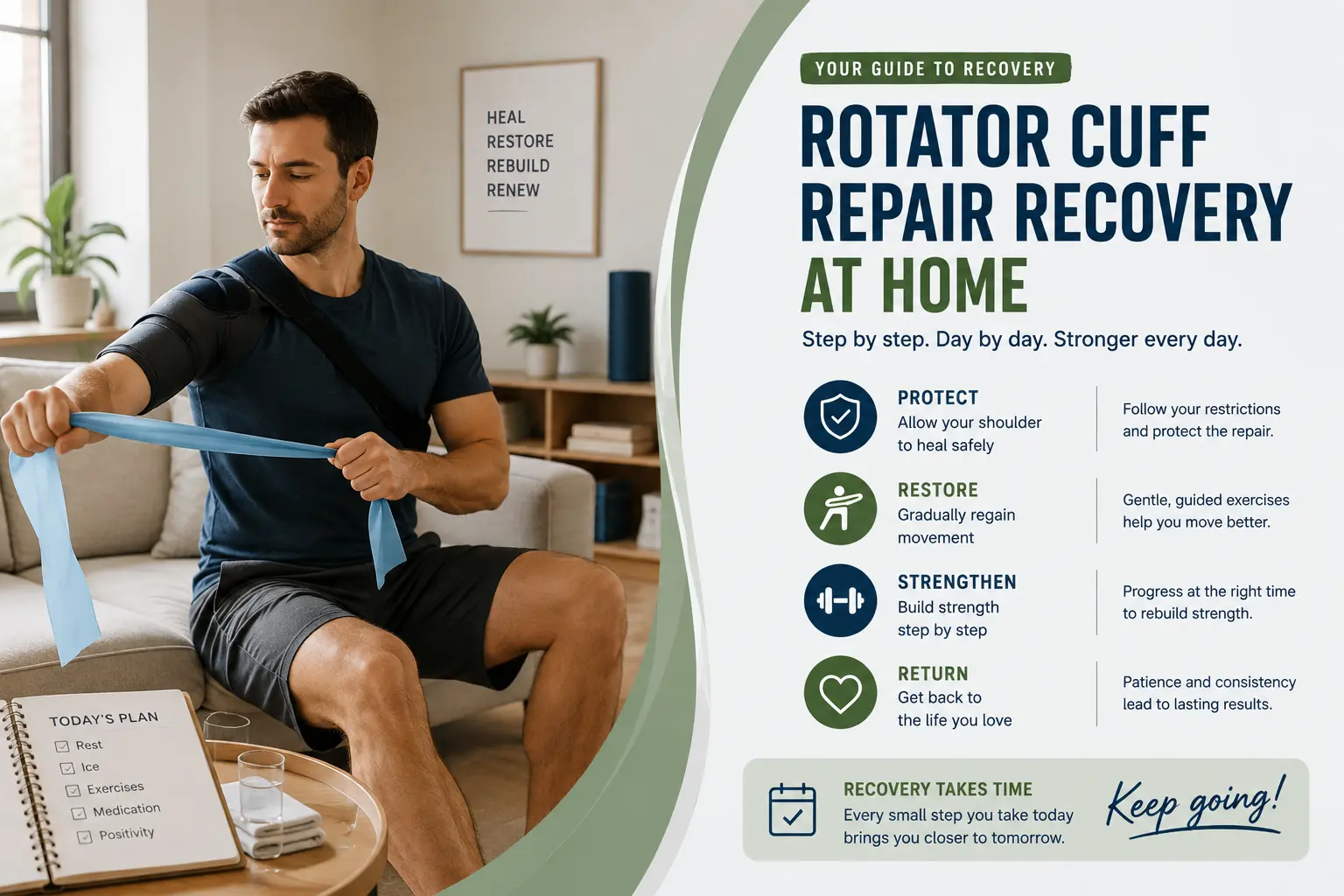

Recovery at home after rotator cuff repair usually takes months, not weeks. Daily tasks such as sleeping, dressing, showering, driving and working may need temporary changes while the tendon heals. Some people need up to a year to regain enough strength for their usual activities.
Your own timeline may be faster or slower depending on the size and location of the tear, tissue quality, the type of repair, other procedures performed at the same time, your work and sport, and how your shoulder responds to rehabilitation. Your surgeon's and physiotherapist's instructions take priority over any general timeline.
This article provides general information and does not replace advice from your surgeon, GP or physiotherapist. Follow the rehabilitation plan provided by your treating team.
What to expect at home after rotator cuff repair
- Protection comes first: the repaired tendon needs time to heal to the bone.
- Movement is introduced in stages: passive, assisted and active movement are not interchangeable.
- Strength returns later: feeling less pain does not necessarily mean the repair is ready for lifting.
- Progress is individual: milestones and movement quality are often more useful than a date alone.
- Full recovery can be lengthy: Healthdirect notes that it can take up to a year to regain enough shoulder strength for normal activities.
Why there is no single recovery timeline
A rotator cuff repair reconnects a torn tendon to bone. The biological healing process cannot be judged only by pain. A shoulder may feel more comfortable before the tendon is ready for forceful movement, lifting or sport.
The rehabilitation plan may be adjusted for:
- small, medium, large or massive tears
- single-tendon or multi-tendon repairs
- acute injury compared with a longstanding degenerative tear
- tendon and bone quality
- additional procedures, such as biceps surgery
- diabetes, smoking and other health factors that may affect healing
- the physical demands of work, caregiving and sport
Research comparing earlier and delayed mobilisation has not established one universal schedule for every repair. A 2024 systematic review found no clinically meaningful long-term functional difference between the approaches and supported progression based on individual clinical goals. A 2026 review also reported broadly comparable long-term outcomes, while emphasising caution and individualisation for larger tears and poorer tissue quality.
Set up your home before surgery
Plan on having one arm restricted for a period set by your surgeon. Before the operation, place frequently used items between waist and shoulder height, prepare simple meals and arrange transport. Loose, front-opening clothes are often easier to manage than garments that need to be pulled overhead.
Ask who can help with:
- transport to follow-up and physiotherapy appointments
- shopping, cooking and heavier household tasks
- childcare or other caring responsibilities
- pet care, particularly handling a lead
- work equipment and an approved return-to-work plan
Keep the discharge instructions and contact numbers somewhere accessible. Confirm how to obtain help after hours if pain, the wound or the arm changes unexpectedly.
Sling use, showering and dressing
Your surgeon may prescribe a sling to protect the repair. Ask whether it can be removed for washing, dressing or approved exercises and how the arm should be supported when it is out of the sling. Do not assume that feeling comfortable means the sling is no longer required.
Before leaving hospital, clarify when the wound can get wet and whether the dressing needs to stay covered. Avoid using the operated arm to push, pull or reach while bathing unless that movement has been approved. A stable shower setup and help from another person may be safer early on.
When dressing, many people find it easier to guide the operated arm into a loose sleeve first and remove it last. Ask your treating team to demonstrate the method that fits your restrictions.
How recovery priorities usually change over time
The stages below explain why your day-to-day restrictions change. They are not a week-by-week exercise protocol. Do not start, stop or advance an exercise because it appears in this guide. The operation report and your treating team's protocol determine what is appropriate.
Phase 1: Protect the repair and manage symptoms
Common timeframe: the first days through the early postoperative weeks.
The immediate priorities are wound care, pain control, sleep, safe daily movement and protection of the repair. Your surgeon may prescribe a sling and limits on shoulder movement. The duration varies, so use the sling exactly as directed.
During this phase, your team may discuss:
- how to support the arm when sitting and sleeping
- approved hand, wrist and elbow movement
- whether any shoulder movement is allowed and who should perform it
- showering, dressing and wound care
- medicines and side effects
- signs that require medical review
A practical goal is to organise help before surgery. Cooking, driving, shopping, childcare and overhead tasks can be difficult when one arm is protected.
Phase 2: Gradually restore approved movement
Common timeframe: often begins within the first several weeks and progresses according to the repair.
Rehabilitation may move from passive motion, where the shoulder is moved without the repaired muscles doing the work, to assisted and then active movement. Those stages are different. Moving ahead early because the shoulder feels better can place stress on healing tissue.
Typical goals include improving comfortable movement, reducing guarding and maintaining control of the shoulder blade. Your physiotherapist will usually watch how you move, not just how far you can reach.
Phase 3: Rebuild active control
Common timeframe: commonly develops over the middle months of recovery.
Once the surgeon is satisfied with healing and movement, rehabilitation may focus more on using the arm under its own power. Everyday tasks are reintroduced progressively. Reaching higher, carrying objects and repetitive use can remain limited even when basic movement has improved.
Progress is not always linear. A temporary increase in soreness after a new activity can occur, but persistent or worsening pain should be discussed with the treating team.
Phase 4: Strength, endurance and return to function
Common timeframe: later recovery, often continuing for many months.
Strengthening is usually introduced after adequate healing and movement have been established. The program may progress from light, controlled resistance to tasks that resemble work or sport. Returning to heavy lifting, contact sport or repeated overhead activity requires more than achieving a particular calendar date.
Useful return-to-activity questions include:
- Is the repair sufficiently healed for this level of load?
- Can I complete the movement without compensation?
- Is strength and endurance adequate for the full task, not just one repetition?
- What should I do if pain increases later that day or the next morning?
When can you drive after rotator cuff repair?
There is no reliable universal date for driving. You need enough comfort, movement, strength and reaction speed to control the vehicle and respond to an emergency. A sling, sedating pain medicine or restricted arm use may make driving unsafe.
Ask your surgeon when you may drive and check any insurer requirements. Do not test your shoulder by driving before you have been cleared.
When can you return to work?
Return to work depends on what the job requires and whether the operated arm is dominant. Computer-based work may be possible before manual work, but even desk work can be difficult if commuting, typing, sleep disruption or pain medicine are factors.
A return-to-work plan may include reduced hours, no lifting, no overhead work, altered duties or more frequent breaks. Give your surgeon a clear description of your tasks rather than relying only on your job title.
What about sleep after surgery?
Sleep disturbance is common early in shoulder recovery. Use the sling and sleeping position recommended by your team. Some people are advised to sleep more upright or support the arm with pillows, but the correct position depends on the operation and protocol.
Contact the treating team if pain is repeatedly preventing sleep despite following the medicine plan, or if medicine side effects are causing concern.
Signs to contact your treating team
Your discharge instructions should explain who to contact and when. Seek prompt advice for symptoms such as:
- increasing redness, warmth, drainage or swelling around the wound
- fever or feeling increasingly unwell
- pain that is severe, worsening or not controlled as expected
- new numbness, marked weakness, colour change or unusual swelling in the arm or hand
- shortness of breath, chest pain or another medical emergency
- a fall, sudden force or new injury involving the operated arm
Call triple zero (000) for a medical emergency.
How to prepare for a smoother recovery
- Get the written protocol. Ask what movements and loads are restricted at each stage.
- Plan transport and home help. Arrange this before the operation, not after you discover which tasks are difficult.
- Book rehabilitation as directed. Confirm when physiotherapy should begin and whether the surgeon has a preferred protocol.
- Bring work details to appointments. Include lifting weights, reaching height, driving and repetitive tasks.
- Track meaningful changes. Note pain, sleep, function and exercise response so your team can adjust the plan.
- Avoid comparing timelines. Another person's operation, tear and rehabilitation may be different from yours.
For a broader overview covering different shoulder operations, read the complete guide to shoulder surgery recovery. You can also compare the general phases of shoulder rehabilitation after surgery.
Questions to ask your surgeon
- How large was my tear, and which tendons were repaired?
- Were any other procedures performed?
- How long should I use the sling?
- Which movements must I avoid now?
- When should physiotherapy begin?
- What milestones must I meet before driving, work and sport?
- Who should I contact if my symptoms change?
If you are still choosing a specialist, you can compare shoulder surgeons in Perth by location, clinical interests and available profile information. A directory can help you create a shortlist; your GP and the surgeon should determine whether an operation is appropriate for you.
Frequently asked questions
How long does rotator cuff repair recovery take?
Recovery usually continues for several months, and regaining enough strength for normal activities can take up to a year. The size of the tear, repair details, health factors and activity goals all influence the timeline.
When does physiotherapy start after rotator cuff surgery?
Timing varies. Some protocols introduce controlled movement early, while others protect the shoulder for longer. Follow the plan issued for your specific repair.
Is pain normal during recovery?
Some pain and disrupted sleep are expected, especially early on. Pain that is severe, worsening, associated with fever or wound changes, or different from the pattern your team described needs medical advice.
Can I recover faster by doing more exercise?
Not necessarily. More exercise is not automatically better for a healing tendon. Complete the prescribed exercises at the recommended dose and ask before adding resistance, stretching or gym work.
Will my shoulder return to its previous strength?
Many people improve in pain and function, but full previous strength is not guaranteed. Healthdirect advises that some people may not regain the same strength they had before the injury.
Sources and further reading
- Healthdirect Australia: shoulder surgery (rotator cuff), reviewed January 2026.
- Healthdirect Australia: rotator cuff injury.
- 2024 systematic review and meta-analysis of rehabilitation timing after rotator cuff repair.
- 2026 systematic review of early and delayed mobilisation after rotator cuff repair.