
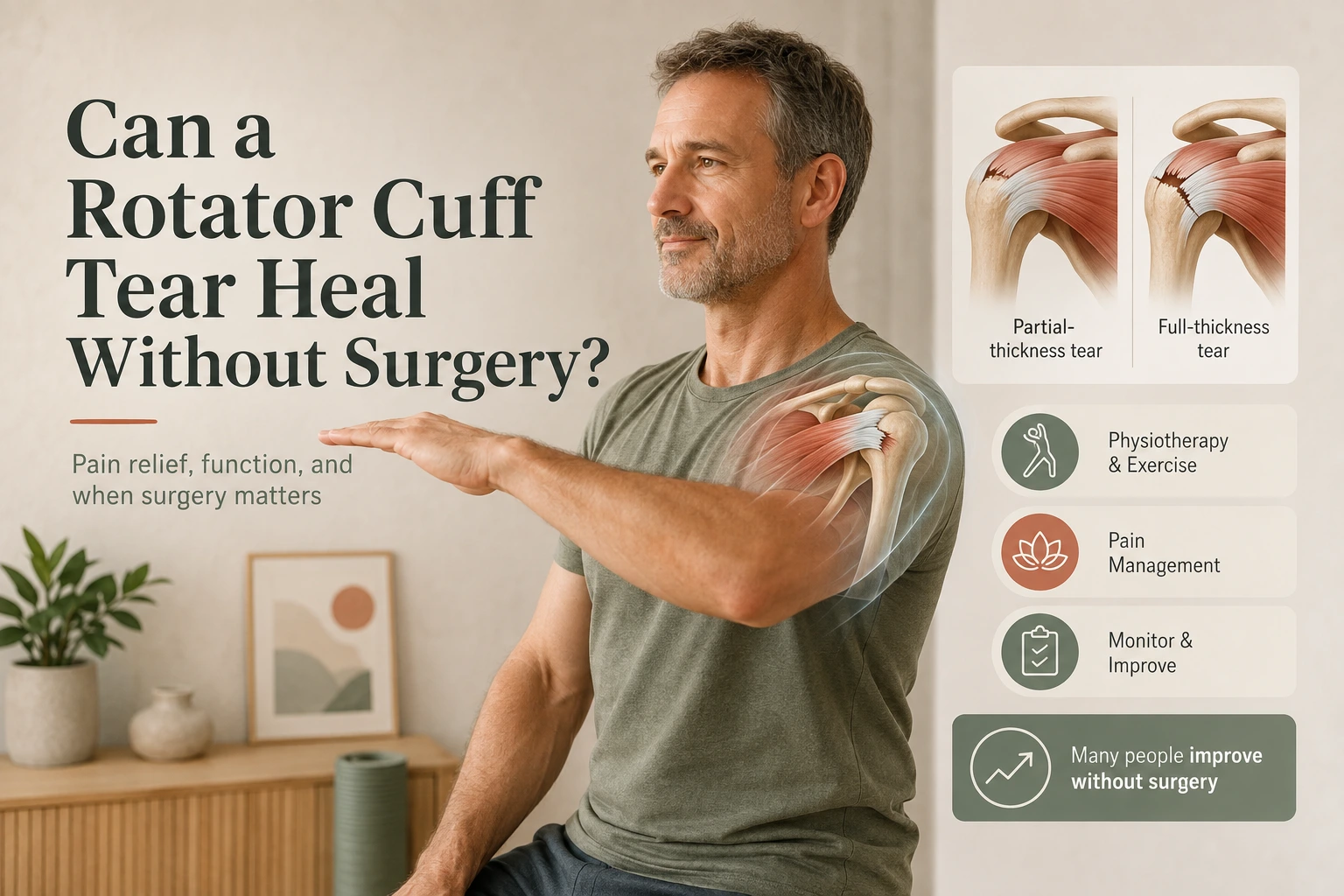

A rotator cuff tear may not reattach itself to the bone without surgery, particularly when it is a full-thickness tear. However, many people can reduce pain, regain useful strength and return to daily activity with physiotherapy, load modification and appropriate pain management. The scan does not decide treatment by itself.
Surgery becomes more relevant when a recent injury causes substantial weakness, the tear is large or progressing, work or sport requires high shoulder strength, or pain and disability continue despite an appropriate non-surgical program. The decision should consider the type of tear, symptoms, function, age, health and personal goals.
This article provides general information and does not replace an individual assessment by a qualified health professional.
What is a rotator cuff tear?
The rotator cuff is a group of four muscles and their tendons that help lift and rotate the arm and keep the ball of the shoulder centred in its socket. A tear affects one or more of these tendons.
Rotator cuff tears are commonly described as:
- partial-thickness, where only part of the tendon depth is torn
- full-thickness, where the tear passes through the tendon
- acute or traumatic, following an event such as a fall or forceful lift
- degenerative, developing gradually with age, tendon change and repeated load
The report may also describe tear size, tendon retraction, muscle atrophy and fatty change. These details can influence whether repair is possible, but they need to be interpreted with the history and examination.
Does a rotator cuff tear always cause pain?
No. Rotator cuff tears become more common with age and can appear on imaging in people who have no shoulder symptoms. Conversely, severe shoulder pain can occur without a full-thickness tear.
Symptoms that can occur with a clinically important tear include:
- pain when lifting or lowering the arm
- night pain, especially when lying on the affected side
- weakness with reaching or overhead activity
- difficulty dressing, washing hair or reaching a shelf
- loss of function after a fall or sudden pulling injury
- clicking or catching, although these are not specific to a tear
A sudden inability to lift the arm after an injury deserves prompt medical assessment. Severe pain with deformity, loss of sensation, a cold or discoloured hand, or major trauma may require emergency care.
Can symptoms improve even if the tendon does not heal?
Yes. Pain and function depend on more than whether a tear remains visible. The other rotator cuff muscles, deltoid, shoulder blade muscles, joint mobility, activity demands and confidence all affect how the shoulder works.
The 2025 American Academy of Orthopaedic Surgeons guideline reports that physical therapy can improve patient-reported outcomes in people with symptomatic full-thickness tears. Healthdirect similarly notes that many people regain good shoulder function through activity changes, exercises and physiotherapy.
This does not mean every tear is harmless. The AAOS guideline also notes that tear size, muscle atrophy and fatty infiltration can progress over years with non-operative management. Monitoring matters when symptoms, strength or function are changing.
What does non-surgical treatment involve?
Individual education and load modification
Temporarily change tasks that cause a strong or lasting increase in pain, while preserving comfortable movement. Complete long-term rest can reduce strength and confidence. The goal is to find a tolerable starting point and progressively rebuild capacity.
Active rehabilitation
The 2025 rotator cuff tendinopathy guideline recommends an active rehabilitation program as initial treatment for rotator cuff-related shoulder pain, including partial-thickness tears. Exercise may address shoulder movement, rotator cuff strength, shoulder blade control and the specific demands of work or sport.
Pain management
A doctor or pharmacist can advise whether paracetamol, an anti-inflammatory medicine or another option is suitable. Medicines can help participation in activity but do not repair the tendon.
Corticosteroid injection
A single injection may offer short-term pain and function improvement in selected patients. It is not a first-line answer for every tear. The AAOS guideline cautions that multiple steroid injections may affect rotator cuff integrity and later repair, so discuss timing and alternatives with the treating clinician.
Review of progress
Rehabilitation should have measurable goals, such as improved sleep, range, strength or work tolerance. If function is not improving, the diagnosis, exercise dose and treatment plan should be reviewed rather than continued unchanged.
When is rotator cuff surgery more likely to be considered?
There is no single scan measurement or symptom duration that automatically requires surgery. An orthopaedic shoulder opinion may be useful when:
- a recent traumatic tear causes marked weakness or loss of function
- pain and disability remain substantial after appropriate non-surgical care
- a full-thickness tear is large, retracting or associated with muscle change
- strength is essential for overhead work, caregiving or sport
- serial assessment suggests the tear or weakness is progressing
- the diagnosis is uncertain or another shoulder problem may need surgery
The age of the tear can matter. A repairable acute traumatic tear may be assessed differently from a long-standing degenerative tear with major retraction and muscle change. Prompt referral does not commit the patient to surgery; it preserves the opportunity to understand the options.
Do partial-thickness tears need surgery?
Many low- and intermediate-grade partial tears are treated first with physiotherapy and activity modification. The AAOS guideline states that physical therapy can improve outcomes for these tears, while surgery can improve outcomes when pain and functional impairment persist after appropriate non-operative treatment.
Higher-grade partial tears, persistent weakness and failure of a structured program may lead to a surgical discussion. The surgeon will consider tear depth and location, tendon quality, activity needs and whether the symptoms truly arise from the tear.
Do full-thickness tears need surgery?
Not always. Both physical therapy and surgery can improve symptoms in many small- to medium-sized full-thickness tears. A person with manageable pain and improving function may reasonably continue non-surgical care with follow-up.
Surgery may be favoured when weakness and disability remain unacceptable, repair is feasible and the expected benefit justifies the recovery and risks. The AAOS guideline reports better outcomes when a repaired tendon heals compared with physical therapy or an unhealed repair, but healing is not guaranteed.
Which scan is used for a rotator cuff tear?
Ultrasound and MRI can both assess rotator cuff tendons. An X-ray does not show the tear directly but can identify arthritis, fracture and changes in bone shape. The appropriate test depends on the examination, suspected condition, availability and whether the result will change management.
Imaging is most useful when it answers a clinical question. A report should not be treated separately from the person's symptoms, strength and goals.
What does rotator cuff repair involve?
Rotator cuff repair usually uses stitches and anchors to reattach the tendon to bone, commonly through arthroscopic keyhole surgery. The operation may also address other relevant findings, but routine additional procedures are not automatically beneficial for every patient.
Risks include infection, stiffness, anaesthetic complications, nerve injury, ongoing pain, failure of the tendon to heal and re-tear. Recovery requires a period of protection followed by progressive rehabilitation. It often takes months rather than weeks.
For practical planning, read the rotator cuff repair recovery-at-home guide and the broader shoulder rehabilitation timeline.
How do you choose a shoulder specialist?
A GP, physiotherapist or sports physician may begin the assessment and non-surgical plan. A surgeon becomes relevant when the decision concerns repair, another operation or the risk of delaying treatment.
When a surgical opinion is recommended, compare shoulder surgeons in Perth by stated clinical focus, qualifications, practice locations and hospital affiliations. Confirm current registration using the AHPRA register.
A valid referral is generally required to claim the relevant Medicare specialist benefit. See how orthopaedic referrals work in Australia.
Questions to ask about a rotator cuff tear
- Is this a partial or full-thickness tear?
- Does the tear explain my pain and weakness?
- Is it acute, degenerative or a combination?
- Is there tendon retraction or muscle change?
- What should a non-surgical program include?
- How will we monitor strength, function or tear progression?
- What is the likely benefit of repair in my situation?
- What could happen if I wait?
Frequently asked questions
Can physiotherapy make a rotator cuff tear worse?
An appropriately designed program aims to improve capacity without repeatedly provoking severe symptoms. Exercise should be adjusted to the tear, pain response and activity needs. New major weakness or worsening function should be reassessed.
Can you live with a full-thickness rotator cuff tear?
Many people manage well without surgery, particularly when pain and function improve with rehabilitation. Others have unacceptable weakness or progressive symptoms and choose repair after specialist assessment.
Does a larger tear always hurt more?
No. Tear size and pain do not match perfectly. Function, inflammation, other shoulder structures and individual activity demands also affect symptoms.
When should a tear be assessed promptly?
Arrange prompt assessment when a fall or sudden force is followed by substantial weakness or inability to lift the arm. Seek urgent care for deformity, loss of sensation, a cold or discoloured hand, or major trauma.