
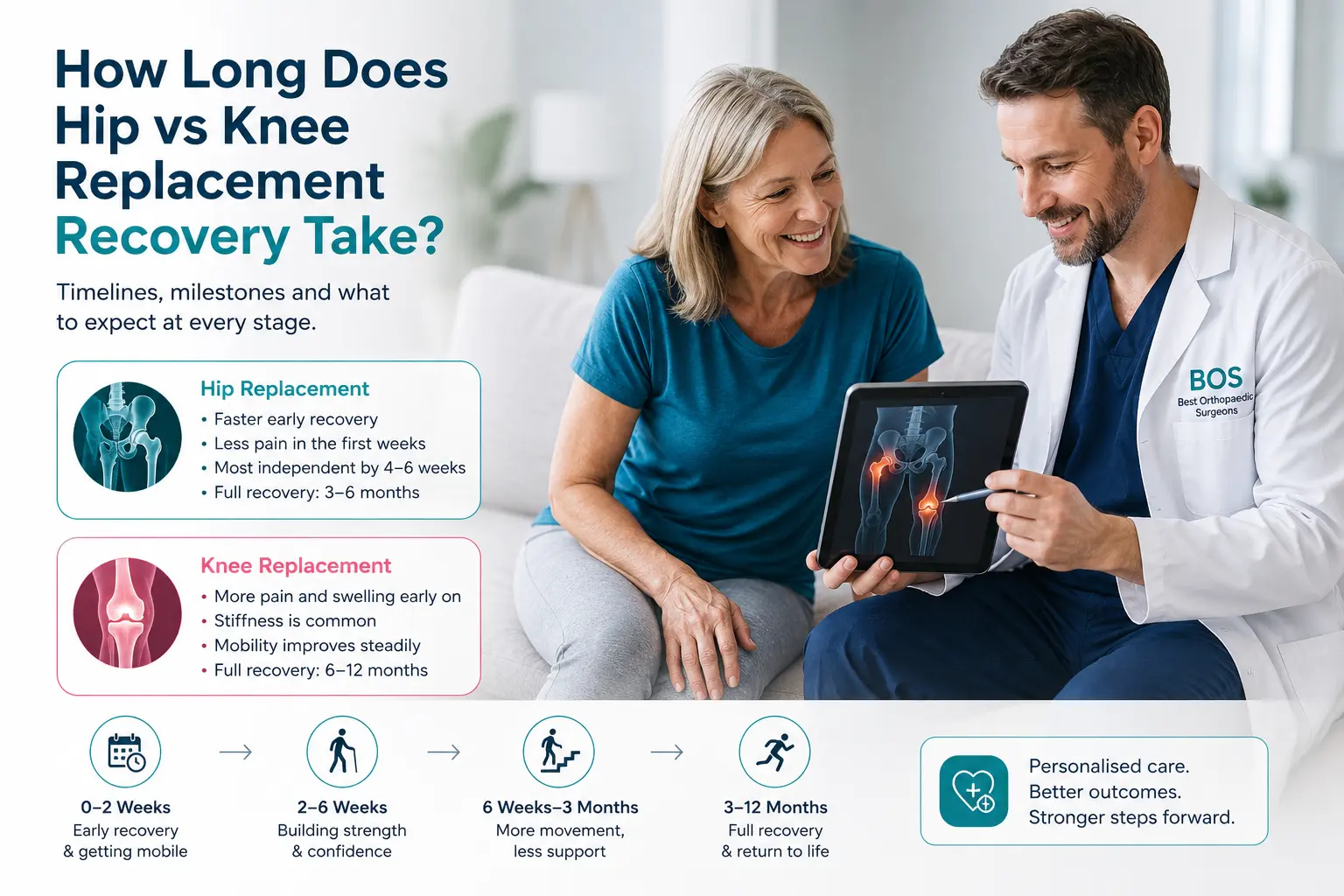

How Long Does Hip vs Knee Replacement Recovery Take?
Almost every patient scheduled for joint replacement asks their surgeon the same question before going under: "Which is harder to recover from, the hip or the knee?" It's a fair question, and the honest answer surprises most people. Both surgeries replace a damaged joint with a prosthesis, both get you moving within 24 hours of the procedure, and both deliver real, lasting pain relief. But the recovery journey feels completely different depending on which joint you're having replaced, and understanding the hip vs knee replacement recovery time differences will help you prepare properly.
Here's the core truth: hip replacement tends to have a faster, smoother early recovery with a less steep pain curve. Knee replacement is generally more demanding in the first six weeks, with more prominent swelling and stiffness, and full recovery commonly takes up to twelve months. Knowing the specific milestones to expect for each procedure, and why the timelines diverge, sets you up for a better outcome.
This article gives you concrete, realistic timelines for both procedures, explains what influences how quickly you'll recover, and ends with practical questions to ask before your surgery. If you're based in Western Australia, Best Orthopaedic Surgeons (BOS) is a dedicated orthopaedic directory that helps you find surgeons who offer personalised recovery guidance from day one, not just generic averages. That kind of specificity matters more than most people realise.
Why Hip and Knee Replacement Recovery Feel So Different
The divergence comes down to anatomy and surgical reality. Hip replacement involves swapping out a ball-and-socket joint. Modern surgical techniques, particularly the anterior approach, also called total hip arthroplasty through an anterior corridor, achieve this with relatively limited disruption to the surrounding muscles. The result is that many patients report substantial pain reduction within the first two to six weeks, with some noticing improvement as early as the first two weeks.
Knee replacement is a different proposition entirely. The surgery reshapes multiple bone surfaces: the end of the femur, the top of the tibia, and often the underside of the kneecap. The surrounding soft tissue bears the full impact of that work. Post-operative pain, swelling, and stiffness are generally more pronounced and last significantly longer. That's not pessimism; it's the physiology of the procedure.
The Pain Profile in the First Two Weeks
Hip replacement patients commonly reduce their analgesic use within the first two weeks as pain intensity falls relatively quickly. Knee replacement patients, by contrast, may need more consistent pain management through weeks two to four. That typically includes anti-inflammatory medication, ice, elevation, and, in some cases, short-term opioids for breakthrough pain.
Regular icing and elevation are strongly recommended during this window and can directly reduce swelling that might otherwise limit how well the joint bends over the long term. These measures can help protect range of motion during the critical early weeks.
What "Faster Recovery" Actually Means for Your Hip
"Faster" does not mean effortless. Hip replacement still requires appropriate precautions, consistent physiotherapy, and real patience. What it means in practice is that the discomfort curve is usually less steep and functional milestones often arrive sooner.
For many patients, this translates to noticeably better daily function by the end of week four, while knee replacement patients may still be working intensively in physiotherapy and relying on walking aids.
The First Six Weeks: What Your Body Is Going Through
Both hip and knee replacement patients are commonly mobilised within 24 hours of surgery. That timing still surprises many people, but early movement is important for reducing the risk of blood clots and beginning rehabilitation.
Your exact mobility plan will depend on your surgeon's instructions, your overall health, the surgical approach used, and how your body responds during the first day after surgery.
Hip Replacement: 0 to 6 Weeks
The typical progression moves relatively quickly. Many patients go from using a walking frame or crutches in hospital to a single crutch or cane within one to two weeks.
Depending on the surgical approach, precautions may include avoiding positions that increase the risk of dislocation, such as crossing the legs or bending the hip beyond the limit provided by the treating team.
By weeks four to six, many patients have regained meaningful independence in basic daily activities, including getting dressed, moving around the home, and managing personal care. The anterior hip approach may accelerate this phase for some patients because it can involve less disruption to surrounding muscles.
Knee Replacement: 0 to 6 Weeks
This phase is usually more demanding. Pain, swelling, and stiffness are often the dominant features throughout the first four weeks, and some patients may still rely on a walker or other walking aid during this period.
Range-of-motion exercises must be completed consistently, even when they feel uncomfortable, because early movement can influence how well the knee bends over the long term.
Swelling can persist for three to six months after a total knee replacement, and mild residual swelling for up to a year is not unusual. Your surgeon and physiotherapist will advise you on what level of swelling is expected and when it should be reviewed.
Key Milestones in Hip vs Knee Replacement Recovery
Walking, climbing stairs, driving, returning to work, and resuming normal activities are the milestones patients ask about most directly. Knowing when to expect each one can help you plan leave from work, arrange household support, and set realistic goals with your physiotherapist.
When You'll Walk Without a Cane
Hip replacement patients often stop using a cane between weeks two and four, sometimes sooner, particularly when recovery is uncomplicated.
Knee replacement patients more commonly use a cane for four to eight weeks, with some needing it for longer because of ongoing swelling and quadriceps weakness. The quadriceps muscles can take time to fully re-engage after knee surgery, and that weakness may affect walking confidence even after the pain begins to settle.
Navigating Stairs
Patients undergoing either procedure may begin navigating stairs within the first one to two weeks using a handrail and the technique taught by their physiotherapist.
Knee replacement patients often find stairs challenging for longer because each step requires the knee to bend through a range that may remain uncomfortable during the early recovery period.
Returning to Driving
Driving is often considered at around four to six weeks after either procedure, provided you are no longer taking medication that affects alertness and can control the vehicle safely.
Surgery on the right leg requires particular consideration because the operated leg must be able to apply full braking force quickly and safely. You should not return to driving until your surgeon has cleared you.
Returning to Work and Resuming Normal Activities
The return-to-work timeline depends heavily on the nature of your job. The difference between hip and knee recovery can be significant enough to influence how much leave you should arrange.
Desk Work and Light Activities
Hip replacement patients may return to sedentary or desk-based work at around two to four weeks, assuming the commute is manageable and extended sitting is comfortable.
Knee replacement patients commonly need around four to eight weeks before sustained sitting becomes comfortable. Knee flexion and residual swelling can limit how long the leg can remain in one position without discomfort.
Working from home or returning through reduced hours can make the early transition easier for patients recovering from either procedure.
Physical Work, Sport, and Longer-Term Activity Goals
Both surgeries may require eight to twelve weeks or longer before physical or manual labour is appropriate. The exact timeline depends on the physical demands of the role and the progress of your rehabilitation.
Low-impact recreational activities such as walking and cycling may resume by approximately three months for many patients. Higher-demand goals, including hiking, recreational tennis, or returning to gym training, may require six months to a year.
Knee replacement patients often reach these milestones later within that range than hip replacement patients. By twelve months, both groups commonly report major improvements in pain, mobility, and quality of life.
Factors That Speed Up or Slow Down Your Recovery
Recovery timelines are averages, not guarantees. Several surgical and patient-specific factors influence where you fall within the expected range.
Surgical Factors: Approach and Implant Type
The anterior hip approach is associated with less muscle disruption and may provide faster early functional recovery than some posterior approaches. This difference is most noticeable during the first few weeks.
For knee replacement, a partial or unicompartmental knee replacement can produce faster recovery and less stiffness than a total knee replacement because less bone and soft tissue are involved.
Implant type and fixation technique may also affect early weight-bearing instructions. Cemented implants, for example, can provide immediate stability for some patients, although the appropriate option depends on bone quality, age, anatomy, and surgeon preference.
Patient Factors: Weight, Age, and Overall Health
A higher body mass index may increase wound complication risk, slow rehabilitation, and place greater mechanical stress on the implant during recovery. The level of risk increases gradually and can become more significant at very high body weights.
Age alone does not determine whether someone will have a poor outcome. Overall fitness, muscle strength, mobility before surgery, smoking status, diabetes control, and other health conditions often matter more than age as an isolated number.
Bilateral surgery, where both joints are replaced during one procedure, concentrates rehabilitation into one recovery period but also increases the demands of early recovery. It is generally reserved for carefully selected patients, and staged surgery may be safer for many people.
Finding an Experienced Surgeon Who Can Guide Your Specific Recovery
The timelines in this article are useful averages, but averages only take you so far. Your actual recovery depends on your age, fitness, medical history, the surgical approach used, and the extent of your joint damage.
A surgeon who understands your full clinical picture can convert general averages into a personalised recovery plan. That is where broad information about hip and knee replacement recovery becomes genuinely useful for your individual situation, and where finding the right orthopaedic surgeon near you makes a real difference.
Questions Worth Asking Your Surgeon Before Surgery
Go into your pre-operative appointment with specific questions. These are worth raising with any hip or knee replacement surgeon:
- Which surgical approach are you using, and how could that affect my early recovery timeline?
- What range of motion can I realistically expect by three months based on my condition?
- What does your post-operative physiotherapy protocol involve, and how often will I attend?
- Are there factors in my health history that might extend my recovery beyond the typical timeline?
These questions do more than gather information. They show your surgeon that you are engaged in your recovery and can lead to more specific, personalised guidance.
How BOS Helps Western Australian Patients Find the Right Specialist
Best Orthopaedic Surgeons (BOS) is Western Australia's dedicated orthopaedic surgeon directory, built specifically for patients navigating hip and knee replacement decisions.
Through BOS, patients can:
- Search verified surgeons by subspecialty
- Find hip and knee arthroplasty specialists
- Read patient reviews
- View detailed surgeon profiles
- Submit questions through the platform
- Find specialists across Perth and regional Western Australia
Once you have a GP referral, you can use BOS to identify and contact a surgeon whose experience and approach align with your individual needs.
Unlike broad health directories that list many types of healthcare providers, BOS focuses exclusively on orthopaedic surgery. Its filters, profiles, and educational content are built around the decisions orthopaedic patients need to make.
The Bottom Line on Hip vs Knee Replacement Recovery
The differences between hip and knee replacement recovery are real and important for planning.
Hip replacement recovery is generally faster, less painful in the early weeks, and reaches functional milestones sooner. Many patients achieve major recovery around the two-to-three-month mark, although continued improvement may occur beyond that point.
Knee replacement recovery is generally more demanding, particularly during the first six weeks. Full recovery commonly takes up to twelve months, with strength, swelling, endurance, and flexibility continuing to improve throughout that period.
Both surgeries can deliver strong long-term outcomes, including reduced pain, improved mobility, and a better quality of life. The journey simply looks different depending on which joint is being replaced.
If you're weighing your options or preparing for a consultation, use Best Orthopaedic Surgeons (BOS) to connect with an experienced hip or knee replacement surgeon in Western Australia. Find a specialist who can answer your individual questions and provide a realistic, personalised recovery roadmap.