

Most patients told they need a joint replacement walk into that conversation with one burning question: how long will this set me back? When comparing hip vs knee replacement, whether your surgeon has flagged both joints or you're helping a family member prepare, the answer is genuinely different depending on which joint is involved. These are two distinct surgeries with different recovery curves, different pain profiles, and meaningfully different satisfaction rates, even though they're routinely grouped together in conversation.
At Best Orthopaedic Surgeons (BOS), we regularly hear from Western Australian patients who want to understand this comparison before their first specialist appointment. Some are trying to set realistic expectations. Others want to know which questions to ask. This guide walks through what actually differs between total hip arthroplasty and total knee arthroplasty, drawing on current evidence, so you arrive at your consultation prepared rather than overwhelmed.
What each surgery actually involves
When hip or knee replacement becomes the right call
Both surgeries are typically recommended after conservative treatment stops working. Physiotherapy, weight management, anti-inflammatory medications, and corticosteroid injections can manage joint pain for years, but when severe osteoarthritis, inflammatory arthritis, avascular necrosis, or post-traumatic joint damage progresses to the point where daily function is significantly affected, surgery becomes the most effective path forward. A surgeon makes this decision based on imaging, a functional assessment, and the patient's age and activity level, not on pain alone.
The Australian Orthopaedic Association's approach is indication-based: both hip and knee replacement are offered for end-stage symptomatic arthritis after conservative care has failed, and the decision usually isn't a choice between the two joints. It comes down to which joint is the dominant problem and whether the patient meets the surgical criteria for that specific joint. For patients still weighing whether hip or knee replacement is appropriate for their symptoms and lifestyle, resources from major academic centres can help frame the decision before you see a specialist, for example, an overview from UC Davis Health on choosing between hip and knee replacement.
How the procedures differ technically
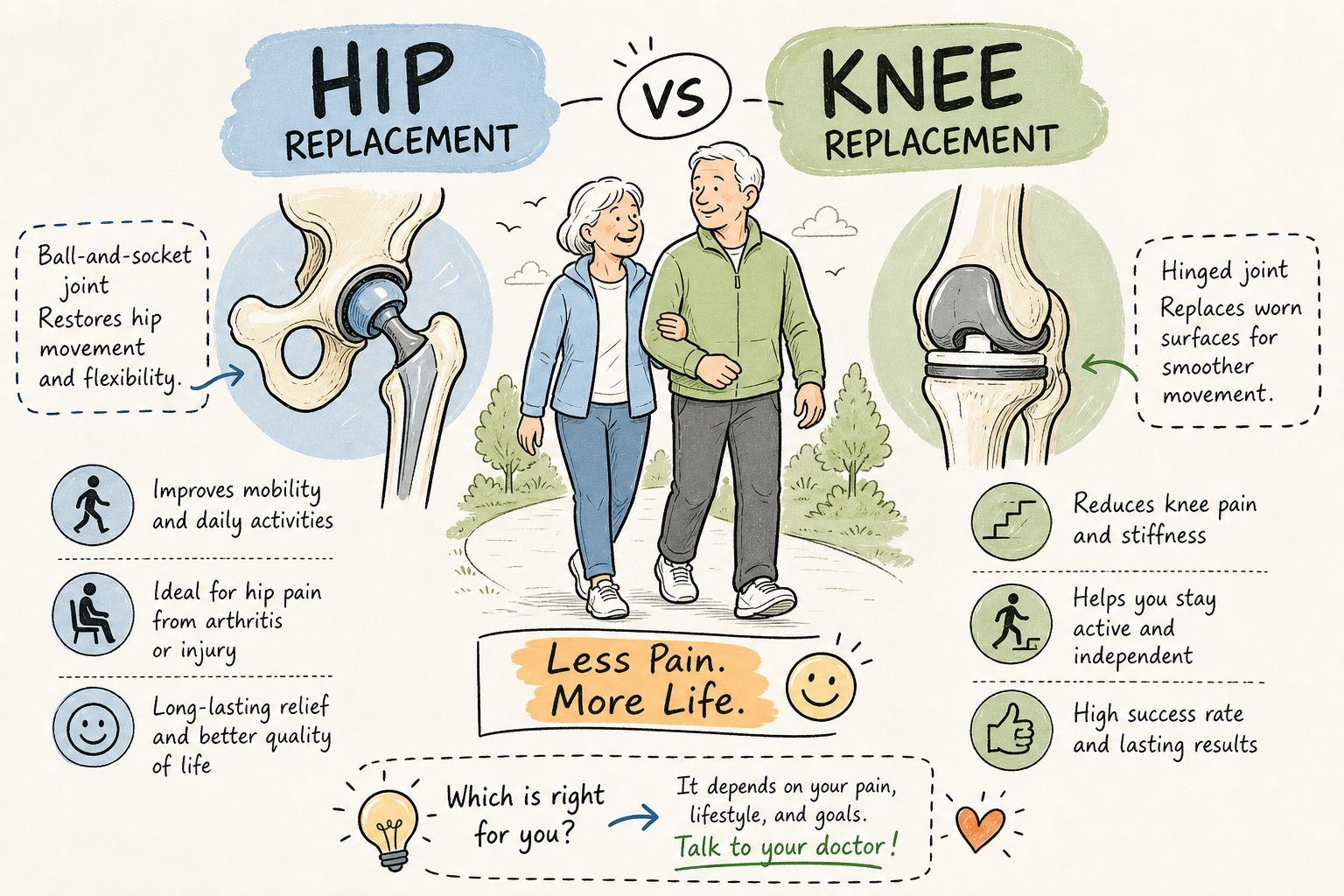
Total hip arthroplasty replaces the damaged ball-and-socket joint with a metal stem inserted into the femur, a ceramic or metal ball, and an acetabular cup fixed into the pelvis. The mechanics are relatively straightforward because the hip is a ball-and-socket joint with a natural range of motion that the prosthesis replicates well. Total knee arthroplasty involves resurfacing the ends of the femur and tibia with metal components, with a plastic spacer in between that acts as the new cartilage surface.
Knee replacement is technically more complex than hip replacement. Getting the alignment right and balancing the soft tissues around the knee is demanding, and when those elements aren't perfectly calibrated, patients notice it. Studies linking alignment and soft-tissue balance difficulties to lower patient-reported outcomes and satisfaction make clear that this complexity has real downstream effects on both recovery difficulty and long-term results.
Surgical approach variations worth knowing
Hip replacement can be performed through an anterior, posterior, or lateral approach. The posterior approach has often been widely used but carries a higher early dislocation risk and comes with stricter post-operative precautions, including avoiding bending the hip past 90 degrees and not crossing the legs. The anterior approach preserves more stabilising soft tissue, typically results in fewer movement restrictions after surgery, and has a lower dislocation risk, though the technique is more demanding for the surgeon. For clinicians and patients wanting a detailed reference on approach selection and best-practice technique, the Arthroplasty Society's guidelines for primary hip replacement are a useful resource.
For knee replacement, the choice between a partial (unicompartmental) and total replacement is worth discussing with your surgeon. Partial replacement preserves more of the natural knee when only one compartment is damaged, with a faster recovery, but it isn't appropriate for everyone. The specific approach and implant type are decisions to raise directly at your consultation.
Hip vs Knee Replacement: Recovery Timelines
Hospital stay and the first weeks home
Both surgeries typically involve a hospital stay of one to three days, with same-day discharge becoming more common for suitable patients. The early divergence in recovery begins almost immediately. Hip replacement patients often walk the same day with full weight-bearing, and many manage light daily tasks within two to six weeks. Knee replacement patients also walk early, but the process involves noticeably more pain and stiffness, with most people returning to routine activities somewhere between four and eight weeks.
The difference isn't subtle. Many hip patients report substantial relief of arthritic pain within the first month, often describing the early experience as a clear improvement from the start. Knee patients are often working harder than they expected, particularly with physiotherapy exercises focused on regaining flexion and extension in the joint.
Driving, work, and the milestones patients ask about most
For hip replacement, driving typically resumes within two to six weeks (once off narcotic pain relief and with surgeon clearance), desk work in a similar window, and physically demanding jobs in six to twelve weeks. For knee replacement, driving involving the right leg often takes four to six weeks, desk work four to eight weeks, and physical roles eight to twelve weeks or longer. These are typical ranges, not guarantees, and your surgeon's specific protocol and how your own recovery progresses both influence the timeline.
Return to low-impact sport follows a similar pattern: hip replacement patients are often cleared for swimming, cycling, and golf around the two to three month mark; knee replacement patients typically reach those same activities a little later, with full comfort during sport sometimes taking six months or more.
How long full recovery actually takes
Hip replacement patients generally reach full recovery in three to six months, with some continued improvement up to the one-year mark. Knee replacement full recovery commonly takes six to twelve months, and stiffness or residual swelling well past the three-month mark is common rather than exceptional. "Full recovery" means feeling genuinely normal, not just being able to walk, and by that measure, the knee consistently takes longer to get there.
Post-op Pain, Swelling, and Stiffness: Hip vs Knee Replacement
Pain levels in the first few weeks
Hip replacement generally produces less post-operative pain than knee replacement. Many hip patients describe their surgical soreness as manageable, and because the arthritic pain disappears quickly, the early experience often feels like a clear net improvement from day one. Knee patients frequently describe the first few weeks as harder than they anticipated. The knee has more soft tissue to heal, the surgical site is more complex, and the pain can genuinely exceed what patients expected, particularly during physiotherapy sessions.
Setting realistic expectations here is important. Patients who go into knee replacement expecting it to feel like hip replacement often end up frustrated. The early weeks are a different experience, and knowing that in advance makes a meaningful difference to how patients manage the recovery.
Swelling and stiffness through month three
Knee replacement swelling is typically more pronounced than after hip surgery and can persist for twelve weeks or longer, consistent with what postoperative outcome studies report on healing timelines. Morning stiffness and stiffness after sitting are consistent complaints through the first three months, and they're a normal part of the healing process rather than a sign something has gone wrong. Hip replacement swelling is milder and resolves faster, and while stiffness is present early on, it rarely dominates the recovery the way it does after knee surgery.
By the three-month mark, most hip replacement patients are moving comfortably and back to most of their regular activities. Knee replacement patients are usually much improved at three months, but many are still working through residual symptoms. This gap in the early recovery experience is one of the most consistent findings in the literature.
Complications: Hip vs Knee Replacement
Risks shared by both procedures
Infection, deep vein thrombosis, and implant loosening over time are risks associated with both procedures. Overall complication rates are low, generally cited in the two to five percent range for major complications in both surgeries, based on large registry and cohort data. Obesity, high-impact activity, and normal wear over time all increase loosening risk. Implants in both joints typically last fifteen to twenty years in well-selected patients, though individual results vary based on age, activity, and implant type. For practical strategies and system-level efforts aimed at reducing complication rates, see discussions from leading institutions such as Johns Hopkins Medicine on reducing joint replacement complications.
Where the risk profiles diverge
Hip replacement carries a specific risk of dislocation, particularly in the early post-operative period where the new joint can move out of position if precautions aren't followed. The posterior approach carries a higher dislocation risk than the anterior approach, which is partly why surgical approach matters as much as it does. Knee replacement doesn't carry the same dislocation risk, but instability from poor ligament balancing is a more knee-specific concern. These differences explain why post-operative precautions look quite different for each surgery.
The distinct risk profiles aren't reasons to avoid either surgery. They're reasons to discuss your specific risk factors with your surgeon beforehand and to understand what precautions you'll need to follow.
What typically drives a revision
Infection and loosening are the most common revision causes for both joints. Dislocation is a hip-specific driver; instability is the more knee-specific one. According to Australian Orthopaedic Association National Joint Replacement Registry (AOANJRR) data, ten-year survivorship sits at approximately 94 to 96 percent for hip replacement and 92 to 95 percent for knee replacement. At twenty years, hip replacement shows slightly better durability overall. Revision surgery is often considerably more complex than the original procedure, involving challenges such as scar tissue, bone loss, and infection management, which is a strong reason why choosing an experienced surgeon for the first operation makes a meaningful difference in long-term outcomes.
Long-term outcomes and patient satisfaction
What the data shows about satisfaction rates
Patient satisfaction after total hip arthroplasty sits around 94 to 95 percent in modern cohorts, based on large prospective studies and registry-linked patient-reported outcome data. Total knee arthroplasty satisfaction sits closer to 80 to 85 percent, with roughly 15 to 20 percent of knee patients reporting dissatisfaction across multiple systematic reviews. This gap is well-documented and worth understanding before surgery. The knee's lower satisfaction rate isn't primarily driven by implant failure. It's driven by persistent pain, stiffness, and unmet functional expectations, problems the implant itself can't fully address.
A systematic review in The Bone & Joint Journal identifies unmet expectations as the single strongest predictor of dissatisfaction after knee replacement. Patients who expected to feel completely normal and pain-free within a few months are significantly more likely to report being dissatisfied, even when the surgery went technically well. This makes pre-surgical expectation-setting with your specialist one of the most important conversations you can have.
Functional outcomes and implant durability
Hip replacement patients consistently report better functional outcome scores than knee patients at the one-year mark. Pain scores, physical function measures, and quality-of-life indices all tend to favour total hip arthroplasty in head-to-head comparisons. That said, both surgeries deliver meaningful improvements over the pre-surgery baseline, and knee replacement remains highly effective for the right patient. The functional gap between the two is a matter of degree, not a reason to avoid knee replacement when that's the joint that needs attention.
Implant survivorship is strong for both joints. As noted above, total hip arthroplasty shows slightly better long-term durability in the AOANJRR data, but the difference at ten years is relatively small, and both represent reliable long-term solutions for end-stage joint disease.
Finding the right surgeon for joint replacement in Western Australia
Why subspecialty experience matters for this decision
Whether you're heading toward a hip or knee replacement, outcomes are closely tied to the surgeon's specific experience with that joint. A surgeon who performs high volumes of total knee arthroplasty, particularly complex cases, will likely produce different results than a general orthopaedic surgeon doing occasional replacements. The technical demands of alignment and soft-tissue balancing in knee replacement, and the approach-specific considerations in hip replacement, mean that subspecialty focus genuinely matters.
Knowing what to look for in a surgeon, and where to find reliable information about their experience and patient outcomes, is part of making a confident decision. This is especially relevant in Western Australia, where access to specialist information has historically been fragmented.
How BOS helps patients in Perth and regional WA
Best Orthopaedic Surgeons (BOS) is a dedicated orthopaedic directory built specifically for Western Australian patients. Through BOS, you can search for credentialed surgeons by subspecialty, hip replacement, knee replacement, or both, and read verified patient reviews and detailed surgeon profiles. You can also send direct questions through each surgeon's profile page before booking an appointment. For patients in Perth, Fremantle, Bunbury, Geraldton, or regional areas, BOS provides a focused and reliable starting point whether you've already received a GP referral or are still gathering information. As a purpose-built orthopaedic directory, it offers a level of subspecialty depth that broad, general health directories aren't designed to provide.
What to take into your consultation
When comparing hip vs knee replacement, the core takeaway is straightforward: these are different surgeries with different recovery experiences. Hip replacement typically offers faster recovery, less post-operative pain, and higher patient satisfaction. Knee replacement takes longer and involves more stiffness and swelling in the early months, but it still delivers significant functional improvement for the right candidate. The decision comes down to which joint is affected, how severe the damage is, and your individual lifestyle and goals.
Before your appointment, consider raising these specific questions with your surgeon:
- How long until I can realistically return to work, given my specific role?
- What surgical approach will you use and why is it the right choice for me?
- What are realistic outcome expectations given my age, weight, and activity level?
- What is your personal revision rate for this procedure?
- What does rehabilitation look like, and will I need formal physiotherapy?
Understanding the hip vs knee replacement difference before you walk into your consultation puts you in a much stronger position to ask the right questions and set realistic expectations. Finding a surgeon who specialises in the specific joint you need addressed is the most important step you can take, subspecialty experience directly influences outcomes. For patients across Western Australia, Best Orthopaedic Surgeons (BOS) is where that search begins.