
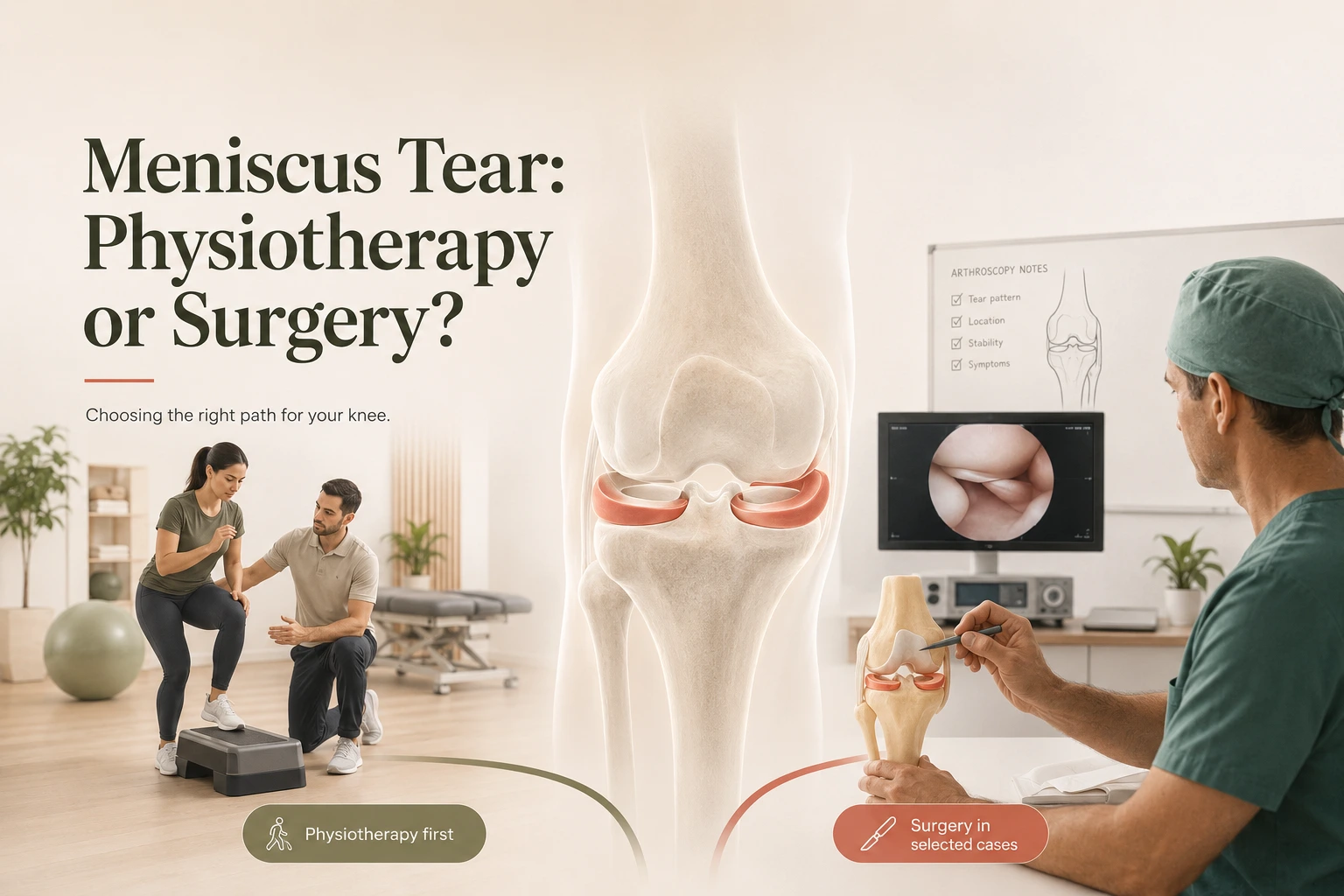

Many meniscus tears are treated first with physiotherapy, especially when the knee is not locked and the tear is degenerative or non-displaced. Surgery is more likely to be considered for a displaced acute tear that blocks knee movement, a repairable traumatic tear, or persistent symptoms that remain limiting after an appropriate rehabilitation program.
The words meniscus tear on an MRI do not automatically mean keyhole surgery is needed. Age, how the injury happened, tear pattern, arthritis, true locking, pain, function and treatment response all change the decision.
This article provides general information and does not replace an individual assessment by a qualified health professional.
What is the knee meniscus?
Each knee has two menisci: a medial meniscus on the inside and a lateral meniscus on the outside. These C-shaped structures are made of fibrocartilage and help distribute load, absorb shock and support joint stability.
A meniscus can tear during a twisting injury or change gradually with age and osteoarthritis. This creates two broad clinical groups:
- Acute traumatic tears follow a recognisable injury, often while the knee is bent and rotating.
- Degenerative tears develop in tissue that has changed over time and may occur with little or no specific injury.
The distinction matters. Evidence and recommendations for an acute repairable tear are different from those for degenerative meniscal change in an arthritic knee.
What are the symptoms of a meniscus tear?
Possible symptoms include:
- pain along the inside or outside joint line
- swelling that develops after activity or injury
- pain with twisting, squatting or deep bending
- clicking, catching or a feeling that the knee may give way
- difficulty fully bending or straightening the knee
- true locking, where the knee becomes physically blocked
Clicking alone does not diagnose a tear, and an MRI tear may not be the main source of pain. Osteoarthritis, ligament injury, kneecap pain and other conditions can produce similar symptoms.
When does a locked knee need urgent assessment?
A knee that is genuinely locked and cannot fully straighten may have a displaced meniscal fragment or another mechanical block. The 2024 AAOS guideline states that displaced or displacing acute tears that restrict range of motion can benefit from acute surgical intervention.
Arrange prompt assessment when the knee is physically blocked after an injury. Go to urgent care or an emergency department if there is major deformity, severe pain, inability to bear weight after significant trauma, loss of circulation or sensation, or a hot swollen joint with fever.
A brief click, momentary catch or stiffness after sitting is not necessarily true locking. A clinician can determine whether movement is blocked mechanically or limited by pain and swelling.
How is a meniscus tear diagnosed?
Assessment begins with the injury, symptoms and examination. Joint-line tenderness and tests that combine bending and rotation can support an acute meniscal diagnosis, particularly when several findings agree.
An X-ray does not show the meniscus but may identify arthritis or fracture. MRI is the preferred imaging test for an acute isolated meniscal tear when imaging is needed. It can describe tear pattern, displacement and associated injuries.
For middle-aged and older adults with symptoms consistent with knee osteoarthritis, routine MRI may add little. The Australian Commission on Safety and Quality in Health Care warns that degenerative meniscal changes are common in knee osteoarthritis and can lead people towards arthroscopy that is unlikely to help.
When is physiotherapy usually the first option?
Physiotherapy is commonly used first when:
- the tear is non-displaced and the knee is not locked
- symptoms are improving after the initial injury
- the tear appears degenerative
- knee osteoarthritis is the more likely source of symptoms
- pain and weakness limit activity but there is no urgent surgical feature
- the person prefers to try non-surgical care first
A rehabilitation program may include restoring range, reducing swelling, improving quadriceps and hamstring strength, retraining balance and gradually rebuilding work or sport tasks. The program should be adjusted to the person's symptoms and goals rather than based on a generic list of exercises.
For an acute non-displaced tear that is not suitable for repair, the AAOS guideline considers physical therapy a useful non-operative option. Physiotherapy is also important after meniscus surgery.
When might meniscus surgery be considered?
An orthopaedic knee opinion may be appropriate when:
- an acute displaced tear restricts movement
- a traumatic tear has a pattern and blood supply that may allow repair
- recurrent locking or mechanical blockage affects function
- pain, swelling and activity limits persist despite appropriate rehabilitation
- there is an associated ligament or cartilage injury requiring specialist planning
- the diagnosis remains uncertain and symptoms are substantial
Timing is individual. A repairable acute tear may need earlier review because the opportunity to preserve the meniscus can change. A non-locking degenerative tear is usually managed non-surgically first.
Meniscus repair versus partial meniscectomy
These operations have different goals.
Meniscus repair
The surgeon stitches the tear to preserve meniscal tissue. Repair is more likely when the tear pattern, location, tissue quality and blood supply provide healing potential. Recovery restrictions may be longer because the repair needs protection.
Partial meniscectomy
The surgeon trims an unstable fragment that cannot be repaired. Recovery may be faster, but removing meniscal tissue reduces the amount available to distribute load. The 2024 AAOS guideline recommends preserving as much functional meniscus as possible when surgery is indicated.
Ask whether the planned operation is a repair or removal, how much tissue may be affected and why that approach fits the tear.
What does Australian guidance say about degenerative tears?
The 2026 online version of the Australian Osteoarthritis of the Knee Clinical Care Standard advises against arthroscopy for uncomplicated knee osteoarthritis. Meniscal tears seen on imaging do not by themselves justify arthroscopy because these changes frequently form part of osteoarthritis.
This advice does not cover every possible meniscal injury. True mechanical locking, septic arthritis, a repairable acute tear or another distinct surgical problem requires separate assessment. The important point is that degenerative MRI findings should not be treated as an automatic operation.
How long should physiotherapy be tried?
There is no universal number of weeks. The appropriate period depends on whether the tear is acute or degenerative, whether repair may be time-sensitive, the presence of locking and whether function is improving.
A reasonable program should include progressive exercise, activity guidance and planned review. Improvement in swelling, range, strength and daily activity supports continuing. Persistent major symptoms despite good participation justify reassessment and possibly a surgical opinion.
What are the risks of knee arthroscopy?
Knee arthroscopy is usually performed through small incisions, but it is still surgery. Risks include infection, blood clot, bleeding, stiffness, nerve or vessel injury, anaesthetic complications, persistent symptoms and further surgery.
A meniscus repair may fail to heal. Partial meniscectomy removes tissue permanently and may affect future joint loading. The expected benefit should be weighed against these risks and the likely course without surgery.
How do you choose a knee or sports surgeon?
For a surgical opinion, look for a clinician whose stated scope includes knee arthroscopy and meniscal repair, not only knee replacement. Compare knee surgeons in Perth or sports orthopaedic surgeons in Perth.
Confirm registration through the AHPRA register. Ask the practice whether the surgeon regularly treats acute and degenerative meniscal conditions and whether existing imaging should be supplied before the appointment.
A valid referral is generally needed for the relevant Medicare specialist benefit. See how to get an orthopaedic referral in Australia.
Questions to ask about a meniscus tear
- Is this tear acute, degenerative or associated with another injury?
- Does it explain my symptoms?
- Is the knee truly locked?
- Is the tear repairable?
- What should physiotherapy include, and how will progress be measured?
- If surgery is proposed, will the meniscus be repaired or trimmed?
- What happens if I delay or continue non-surgical care?
- What are the return-to-work and return-to-sport expectations?
Frequently asked questions
Can a meniscus tear heal without surgery?
Some small tears in areas with better blood supply can heal, while many others remain visible but become symptomatically manageable. Recovery of function does not always require the MRI appearance to return to normal.
Does every meniscus tear need an MRI?
No. Examination and context guide imaging. MRI is useful for suspected acute tears when the result will change treatment, but degenerative tears are common and may not explain pain in an arthritic knee.
Is clicking a reason for surgery?
Clicking alone is not enough. Surgery is more relevant for a displaced repairable tear, true locking or substantial persistent symptoms that match the tear after appropriate non-surgical care.
Can you play sport with a meniscus tear?
That depends on tear type, swelling, stability, strength and the sport. Continuing through recurrent locking or swelling may be unwise. A sports clinician can guide rehabilitation and return criteria.