
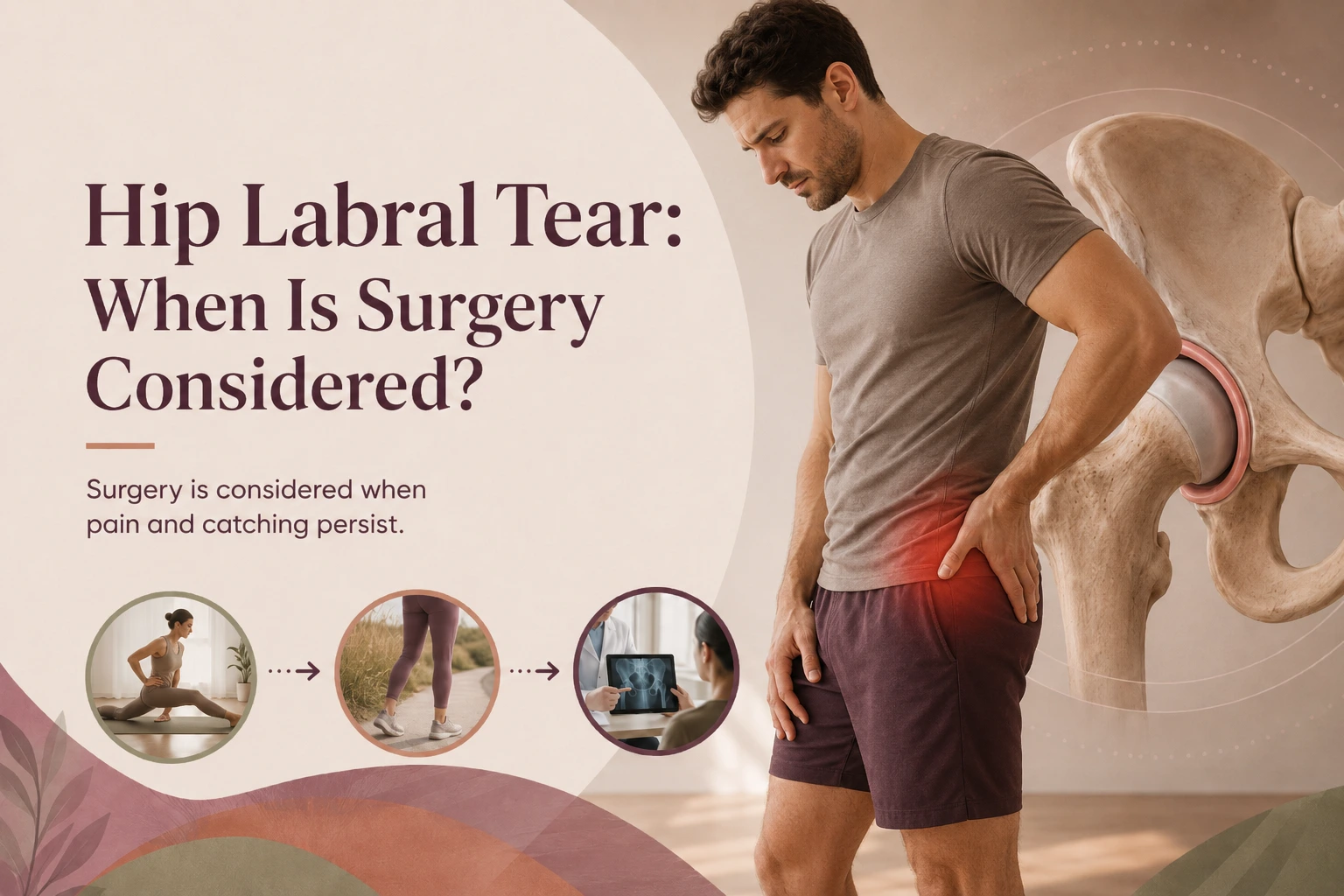

Hip labral tear surgery is usually considered when groin pain, catching and activity limits continue despite appropriate non-surgical care, the symptoms match a treatable problem inside the joint, and advanced arthritis is not the main cause. A tear on an MRI alone is not enough to decide on hip arthroscopy.
Initial treatment often includes activity modification and physiotherapy that addresses hip strength, movement control and the demands of work or sport. Earlier specialist review may be useful for substantial mechanical symptoms, major daily limitations, an acute injury or a diagnosis involving hip dysplasia or another structural problem.
This article provides general information and does not replace an individual assessment by a qualified health professional.
What is the hip labrum?
The hip is a ball-and-socket joint. The labrum is a ring of fibrocartilage around the edge of the socket. It helps deepen the socket, support stability and maintain a seal around the joint.
A labral tear can follow trauma or repetitive loading, but it is often associated with the shape and movement of the hip. Relevant conditions include:
- femoroacetabular impingement syndrome, where the shape and movement of the ball and socket produce painful contact
- hip dysplasia, where the socket provides less coverage and stability
- joint degeneration or osteoarthritis
- hip instability or hypermobility
- acute twisting or impact injury
Treatment should address the whole hip problem rather than treating the word tear in isolation.
What does a hip labral tear feel like?
The 2025 expert consensus on hip labral tears identifies a cluster of anterior groin pain, pain in deep hip flexion and sharp catching pain with rotation as making a tear more likely.
Possible symptoms include:
- deep pain in the groin or front of the hip
- pain with sitting, squatting or bending the hip deeply
- pain when pivoting, cutting or changing direction
- clicking, catching or locking sensations
- reduced tolerance for running or field sport
- stiffness or reduced hip movement
- pain after prolonged sitting or getting out of a car
These symptoms are not specific. Tendon problems, hip osteoarthritis, back-related pain, hernia and other conditions can overlap. Painless clicking is common and does not establish a labral tear.
Can a hip labral tear be present without symptoms?
Yes. Labral changes can be found on imaging in people who do not have hip pain. That is why a scan must be matched to the pain location, physical examination and effect on function.
A useful diagnosis explains the person's symptoms and identifies any underlying morphology, such as impingement or dysplasia, that changes treatment. Treating an incidental tear is unlikely to solve pain coming from somewhere else.
Who should assess suspected hip labral pain?
A GP, sports physician or physiotherapist can begin the assessment. They may examine hip movement, strength, walking, lower-back and pelvic factors and the activities that provoke symptoms.
An orthopaedic surgeon with a hip-preservation or hip-arthroscopy practice becomes relevant when the diagnosis is established or strongly suspected and the decision concerns an operation. This is different from a practice focused mainly on total hip replacement.
How is a hip labral tear diagnosed?
Diagnosis combines history, examination and imaging. No single movement test proves that the labrum is the source of pain.
Plain X-rays
Standing pelvis and specialised hip views show bone shape, joint space, dysplasia, impingement morphology and arthritis. The 2025 consensus recommends radiographs for people presenting with a suspected labral tear.
MRI or MR arthrogram
MRI can assess the labrum, cartilage and surrounding soft tissues. Some services use contrast injected into the joint for an MR arthrogram. Test selection depends on local imaging quality, the clinical question and specialist preference.
Diagnostic injection
When it is uncertain whether pain comes from inside the joint, a clinician may use an image-guided local anaesthetic injection. Temporary relief can add information, but it does not by itself guarantee that surgery will succeed.
What non-surgical treatment is used?
Non-surgical care should be individual and may involve:
- temporarily modifying deep-flexion, pivoting or high-load activities
- progressive strengthening of the hip and trunk
- movement retraining for tasks that reproduce symptoms
- gradual return to running, gym work or sport
- medicines after advice from a doctor or pharmacist
- an injection in selected cases for diagnostic or short-term symptom purposes
The goal is not to force the hip into a supposedly perfect position. It is to improve load tolerance and function while avoiding repeated painful compression. A program should account for whether the hip is stiff, unstable, dysplastic or affected by impingement morphology.
Can physiotherapy heal the labrum?
Physiotherapy cannot stitch torn labral tissue back into place. It can improve symptoms and function by strengthening the surrounding system, modifying provocative loads and addressing movement or conditioning deficits.
Success should be measured through sitting tolerance, walking, training, work and other meaningful activities. If these improve to an acceptable level, surgery may not be needed even if imaging remains unchanged.
When might hip arthroscopy be considered?
The 2025 consensus identifies significant mechanical symptoms, moderate-to-severe pain, limitations in daily activities and high athletic demands as relative reasons for operative consideration. Surgery is more plausible when:
- the symptom pattern and examination fit intra-articular hip pain
- imaging confirms a labral and structural problem that can be treated
- appropriate non-surgical care has not restored acceptable function
- catching or mechanical symptoms remain substantial
- the person understands the recovery, alternatives and material risks
- advanced osteoarthritis is not the dominant problem
Minimal pain or minimal effect on daily life weighs against surgery. Age, joint degeneration, hip dysplasia, symptom duration, other health conditions and prior rehabilitation can all affect the likelihood of a good outcome.
What does hip arthroscopy involve?
Hip arthroscopy uses a camera and narrow instruments inserted through small incisions. Depending on the findings, the surgeon may:
- repair the labrum
- trim tissue that cannot be repaired
- reconstruct a non-viable labrum in selected cases
- reshape a cam or pincer lesion contributing to impingement
- treat associated cartilage damage
- manage the joint capsule to protect stability
The exact procedure may not be fully known until the joint is inspected. Ask what the surgeon expects to find, which alternatives may be used and how underlying dysplasia or arthritis affects the plan.
What are the risks and limits?
Possible complications include infection, blood clot, nerve injury related to traction, numbness, stiffness, heterotopic bone formation, ongoing pain, instability, re-injury and further surgery. Some patients do not improve despite technically successful treatment.
Hip arthroscopy is generally less suitable when advanced osteoarthritis is the main cause of symptoms. Removing or repairing the labrum does not reverse widespread joint degeneration.
What is recovery from hip arthroscopy like?
Recovery depends on the procedure. Crutches and temporary weight-bearing restrictions may be used, particularly after repair or cartilage treatment. Physiotherapy progresses movement, strength and walking before higher-level activity.
Return to running and sport is based on healing, symptoms, strength and performance rather than one universal date. Work planning depends on whether the role is desk-based, involves driving or requires lifting and prolonged standing.
How do you find the right hip specialist?
When hip arthroscopy is being considered, check that the surgeon's documented practice includes hip preservation, labral treatment and femoroacetabular impingement. Compare hip surgeons in Perth and, for sport-related symptoms, sports orthopaedic surgeons in Perth.
Verify current registration through the AHPRA register. For the Medicare and WA referral pathway, read how to obtain an orthopaedic referral in Australia.
Questions to ask at a hip appointment
- Does the labral tear explain my symptoms?
- Is femoroacetabular impingement, dysplasia or arthritis also present?
- What should non-surgical treatment include?
- Would a diagnostic injection add useful information?
- What exactly would arthroscopy treat?
- Would the labrum be repaired, trimmed or reconstructed?
- How does my joint cartilage affect the expected outcome?
- What restrictions and rehabilitation follow surgery?
Frequently asked questions
Can a hip labral tear heal without surgery?
The tissue may not return to its original structure, but symptoms and function can improve with rehabilitation and activity changes. Treatment aims at the person, not only the scan.
Does clicking mean the labrum is torn?
No. Clicking can come from several structures and may be painless. A symptomatic labral tear is more likely when groin pain, catching, examination and imaging form a consistent pattern.
Is hip arthroscopy the same as hip replacement?
No. Arthroscopy treats selected problems inside a native hip joint through small incisions. Hip replacement removes and replaces damaged joint surfaces and is generally used for advanced arthritis.
When should hip pain be assessed promptly?
Seek urgent care after major trauma, inability to bear weight, deformity, fever with a hot swollen joint, or sudden severe pain. Persistent groin pain, catching or activity loss can be assessed routinely by a GP or sports clinician.